[Bureau of Genuine Work] Workslop and Meat Proxy - Terms You Need to Know Before Rolling Out AI
These are two terms I never thought I'd actually say, let alone write an article about. They describe a negative pattern you'll need to watch out for when your team starts using AI.
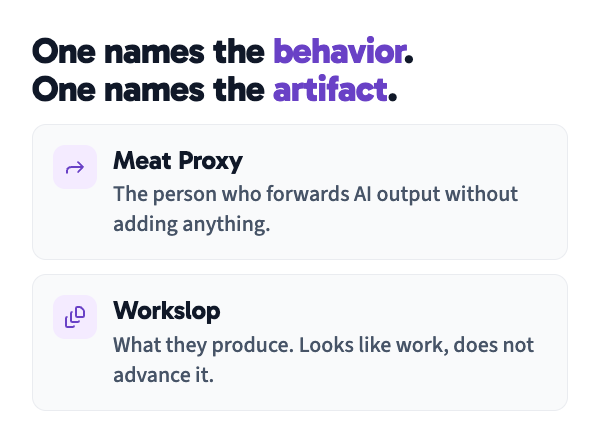
A "Meat Proxy" is a person who sits between an AI and a stakeholder and simply passes output from AI without adding anything. You're a Meat Proxy if you ask AI a question, get an answer, paste it into Slack, and hit send. The model did the thinking, and you only did the transportation.
Workslop is what a Meat Proxy produces. Researchers at BetterUp Labs and the Stanford Social Media Lab coined it for AI-generated content that "masquerades as good work, but lacks the substance to meaningfully advance a given task."
One term names the behavior, the other names the artifact, and together they explain the gap between a team that operates faster and a company that doesn’t.
Here's how to spot the pattern on your own team, what it's costing you, and five things to do about it.
What Meat Proxying is not
Using AI to draft, research, summarize, or think out loud is fine. That's most of the value.
The problem is narrower: passing along output you have not read carefully enough to understand.
The AI involvement is not the tell. The absence of a decision, validation, and verification is.
How to spot Workslop and Meat Proxying on your team
Here are a few common "tells" to watch out for.
Tells by channel
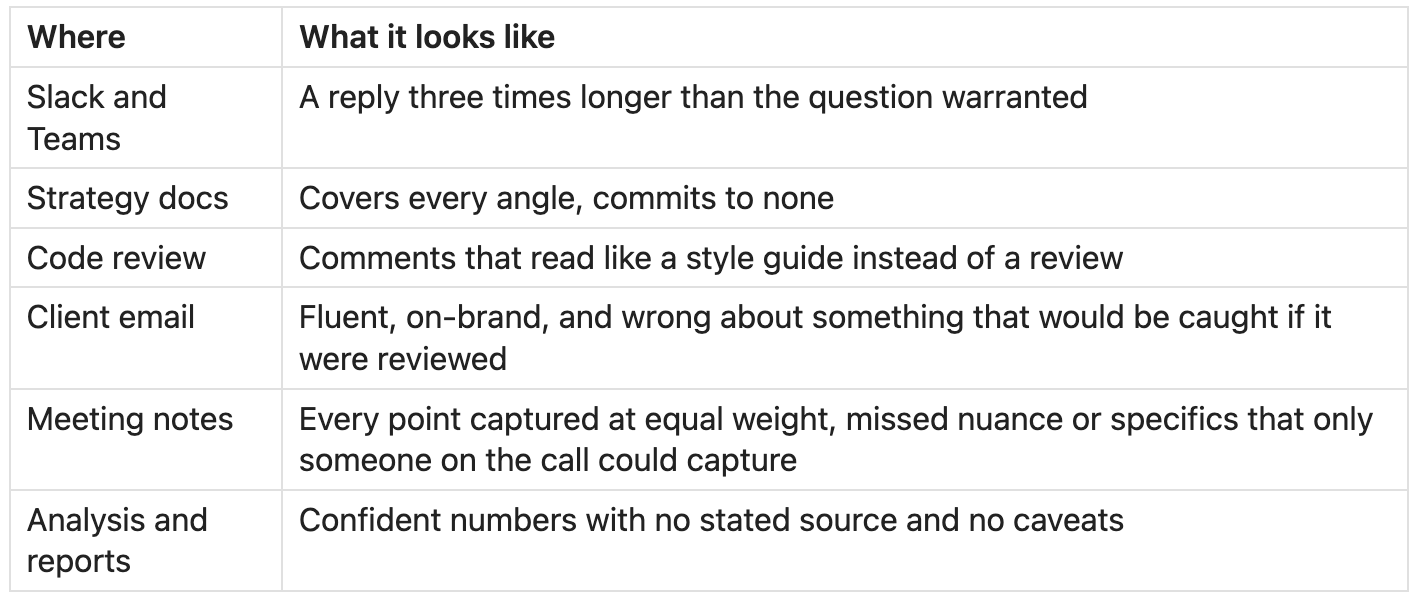
Other areas
Handoffs. By far the most common breeding ground, because forwarding is the path of least resistance when it's a handoff that doesn't force a decision path.
Channels that reward speed. Anywhere response time is visible and quality is not.
Junior people with output pressure. They have the least context to catch a wrong answer and the most incentive to look like they produce output quickly.
You need an SME
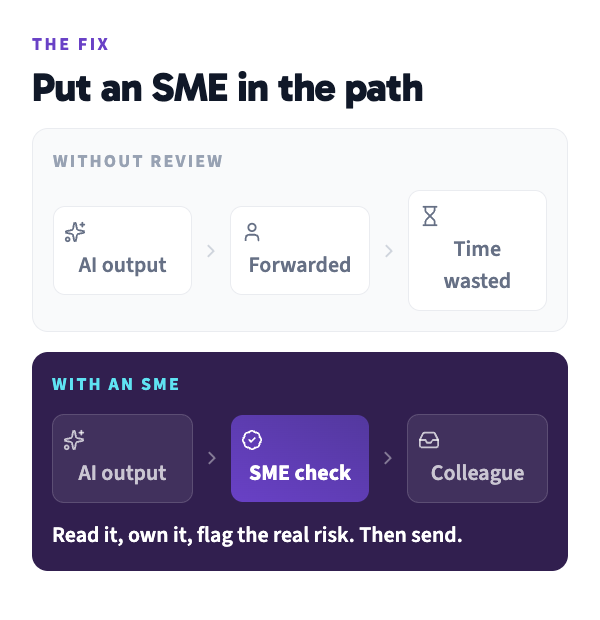
Your best line of defense is having an SME (Subject Matter Expert).
Workslop can be hard to catch when a non-SME is being a Meat Proxy and sending information to another non-SME. But the second Workslop is sent to an SME, it's immediately apparent that this is unverified AI output. This is what you want and it needs to be baked into your process.
I'm not saying, "Don't use AI." But I am saying don't use AI without some level of subject matter expertise in the mix so you can validate the output and ensure you're using the "tool" called AI correctly.
Examples
Step-by-step guides. Someone builds a step-by-step guide from a transcript but doesn't actually try it out and validate that it works.
Emails. Someone drafts with AI and doesn't read it and verify it's what they actually want to say before sending.
Meeting and conversation recaps. Someone takes notes in a 1:1, has AI turn them into a summary, and sends it unread.
Requirements and RFPs. A client or a team assembles a requirements doc with AI, and then nobody in the review meeting can explain what half of it means or how it fits together.
Internal wikis and knowledge bases. Someone generates pages of polished documentation that make the team look impressively organized. A week later, a colleague actually reads it and finds that most of it is wrong.
Specs and plans from the top. An executive generates a 50-page document in half an hour and sends it down as "help," converting 30 minutes of their own time into hundreds of hours of reading across the organization.
Two conditions
Forwarding AI output is not automatically the problem, as long as there's an SME in the mix.
It works fine when two conditions hold:
The sender has read it and owns the output
The team has an explicit shared understanding that this is what forwarding means
Here’s what it looks like when it’s done right: A sales rep (the SME) creates a two-page Claude synthesis of a key account that is better intel than he could have gotten otherwise.
The subject matter expertise, and the time to validate the output, are what make the difference. With both of these in place, the sales rep can say, "Here's Claude's analysis. I've checked it out, and I think the third point is the real risk."
We've already been doing this for decades
To frame it differently, we've been doing this for decades before AI. A "research assistant" will do the heavy lifting, and an SME has to review it to validate that everything is correct. The system hasn't changed; the method of doing the "heavy lifting" has.
What it costs
Out of 1,150 US full-time workers, 41% had received Workslop in the previous month.
A separate survey explains how it keeps happening.
Glean's Work AI Institute polled 6,000 digital workers this June and found that 69% stop carefully reviewing outputs or verifying that the AI's recommendations make sense. Checking is boring, so people quit checking, and the unchecked output enters the workflow for the next person to inherit.
When someone says, "Can you check this for me?" and then pastes a 300-line AI explanation of an error, a contract, or a report and asks a colleague to read it and confirm whether it's right, the entire job just moved to the person who was asked.
Trust is lost
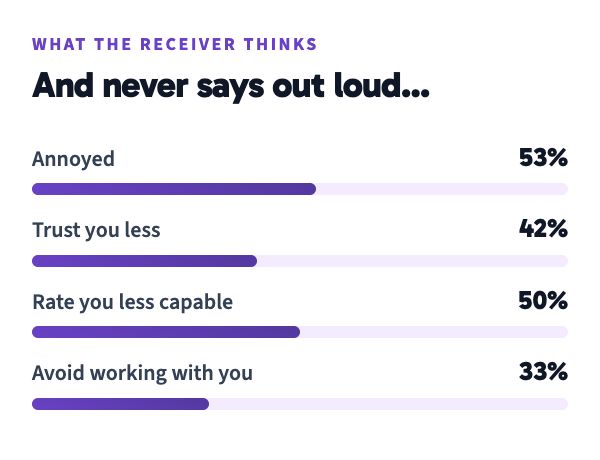
In the BetterUp survey, workers who received Workslop said it changed their view of the sender:
53% were annoyed
42% saw the sender as less trustworthy
Roughly half rated the colleague as less creative, capable, or reliable than before
About a third were less likely to want to work with that person again
The person on the receiving end rarely says any of this out loud, so the sender keeps doing it and quietly loses standing.
Why people do it
Not everyone sets out to dump work on a colleague. So here are three pressures that produce this behavior in good people. It's up to leadership to ensure these don't make their way into the company's culture.
1. Speed became the visible signal. Once a team adopts AI, response times collapse and everyone notices. Thinking for twenty minutes now can be frowned upon in an unhealthy culture, even when it's the job.
2. Volume reads as effort. A long, thorough-looking document feels like more work than three sharp sentences, so it gets rewarded more. AI made long documents nearly free, which means the cheapest possible output now sends the strongest effort signal. That incentive is backward.
3. The cost lands on someone else. Reading, checking, and interpreting are real work, and forwarding moves all of it to the recipient. Five minutes saved becomes two hours spent, but only one of those numbers shows up on the sender's day. Every instance is a small, invisible transfer of labor from the person who chose to use AI without review to the person who is receiving the output.
What to do about it
Here are eight ways to nip your Meat Proxies in the bud, starting with prevention and ending with what to do when Workslop lands in your inbox anyway.
Train your team. Give examples of Workslop and educate them on the costs. Train them to read the output, check it, understand it, and call in an SME for validation if needed.
Make AI use visible, not shameful. People hide AI involvement because disclosure feels like admitting they didn't do the work. Hidden use is what makes unread output dangerous, because the reader has no idea what level of scrutiny to apply. Say plainly that using AI is expected, but passing along unverified output is the thing you don't want to happen.
Stop rewarding volume. Take an honest look at what gets praised in your company. If the thorough-looking 12-page document beats the three-sentence recommendation, you have priced effort by length, and AI will allow your team to create a flood of outputs in that format, for nearly free. Reward the judgment, not the deliverable.
Name who owns the judgment on every handoff. Most Meat Proxying happens in the gap where nobody was clearly accountable for the call. Decide before the work starts whether the sender owns the verdict or the reviewer does. Ambiguity is what lets the judgment slide downstream.
Build the human checkpoint into the system. Norms decay; structure doesn't. Our first rule for any AI system we build is to take the judgment away from the AI by design. When we run Google Ads with Claude, the connection is read-only on purpose: Claude reads the account and generates the campaign structures, keywords, and copy, but it cannot publish, move budget, or change bids. A human has to act, which puts a review step exactly where the money moves. That constraint is not a limitation we're working around. It's the feature.
Make "Is this yours or the model's?" a normal question. Anyone should be able to ask it about any message without it landing as an accusation. It makes the origin of the content visible so the reader knows how much scrutiny to apply. Once the question is routine, people start labeling their own output before anyone has to ask.
Require a human-written summary on top. Nothing gets forwarded without a short TL;DR in the sender's own words. It's a small ask that makes a big impact. Writing an honest two-sentence summary is impossible if you haven't read and understood what you're summarizing.
Give people a better front door. When a team proxies every question to one person, that bottleneck is the actual problem. Stand up a knowledge-bank AI with read-only access to the systems and documents people keep asking about, then point them to it. Build a path to the answer that isn't a human.
The bottom line
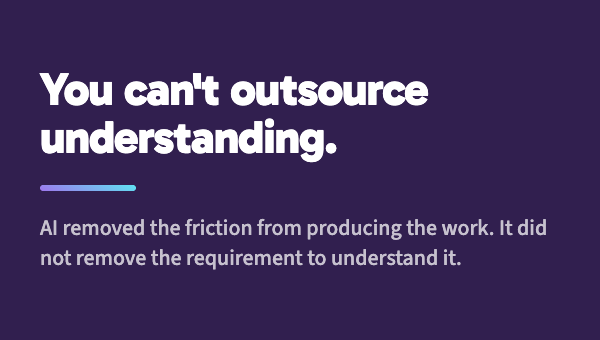
You can't outsource understanding.
AI removed the friction from producing the assets, but it did not remove the requirement to understand it.
It's not about generating the most output. It's about defining a company culture where AI is a tool, and there's still a person behind it who reads it, checks it, and can defend it. That person is not slower. They're the only one actually finishing work.
Want some handy handouts for you team? Download them here!
Directive 001: Don’t be a meat proxy
Directive 002: Run it past an SME
Know someone who'd find this useful?
Forward this to a colleague who keeps receiving suspiciously thorough documents. They can subscribe at your.biggestgoal.ai to get our briefings daily.
Source notes
Workslop definition, and the trust findings (BetterUp Labs + Stanford Social Media Lab, 1,150 US workers): Harvard Business Review, Sept 2025 · BetterUp Labs · Axios · TechCrunch
69% no longer carefully reviewing AI outputs (Glean Work AI Institute, 6,000 digital workers, June 2026): CIO Dive, Jun 10 2026 · Glean Work AI Index
"Don't be a meat proxy" and the reaction to it: gruhn.me, Aug 3 2026 · Hacker News discussion, 673 points · Lobsters discussion