[AI Special Report] They Fired the Humans for AI. Now They're Hiring Them Back.
Earlier this week, TechCrunch reported that Ford quietly rehired about 350 veteran engineers, many of them retirees, after discovering its AI quality tools couldn't do the job alone.
Ford isn't an outlier. This is a pattern every company needs to know about.
It's the flight of a boomerang, and for those that are not careful, that boomerang is going to come back and clock some people right in the face.
The promise that sold the layoffs
For two years, the pitch to every executive was irresistible: AI does the work faster, cheaper, around the clock, and it never quits. Which is all true, but it was also a lot of: Cut the headcount, book the savings, tell the board you're "AI-first." Klarna said it out loud. Between 2022 and 2024, the fintech eliminated roughly 700 customer service roles and handed the work to an OpenAI-built assistant that, at its peak, handled two-thirds of all customer conversations. The efficiency numbers looked incredible.
For a while, this looked like the future. Fire the humans, install the software, watch the margin expand.
Then the bill came due.
The reversal
By mid-2025, Klarna was hiring humans back.
Customer satisfaction had dropped, complaints climbed, and the AI produced generic, repetitive answers on exactly the interactions that mattered most: disputes, fraud claims, financial hardship.
CEO Sebastian Siemiatkowski's own words: "We focused too much on efficiency and cost. The result was lower quality, and that's not sustainable." Klarna now runs a hybrid model: AI on routine volume, humans on anything where the cost of a wrong answer is high.
Ford's version is the same lesson in a different industry. Its VP of vehicle hardware engineering admitted the company "mistakenly thought that by just introducing artificial intelligence and ingesting the design requirements we had, that would produce a high-quality product." It didn't. The rehired "gray beard" engineers now run mandatory weekly design reviews and retrain the AI tools that were supposed to replace them.
Here's the data:
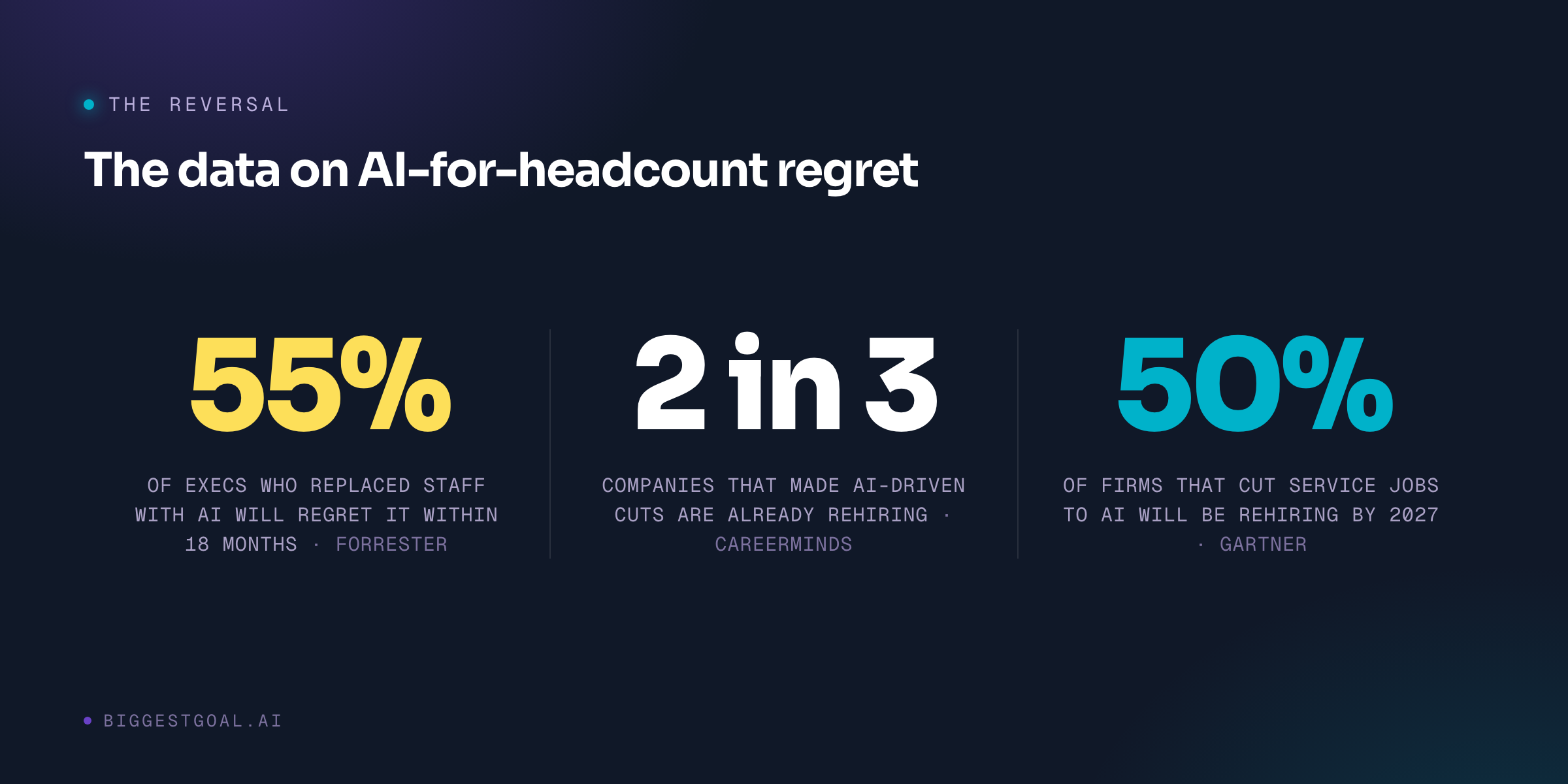
Forrester projects that 55% of executives who replaced employees with AI will regret the decision within 18 months.
A February 2026 Careerminds survey of 600 HR professionals who ran layoffs found that two in three companies that made AI-driven cuts are already rehiring. More than a third have brought back over half the roles they eliminated, and 52% started rehiring within six months.
Gartner forecasts that by 2027, at least half of the companies that cut customer service jobs due to AI will be rehiring those people.
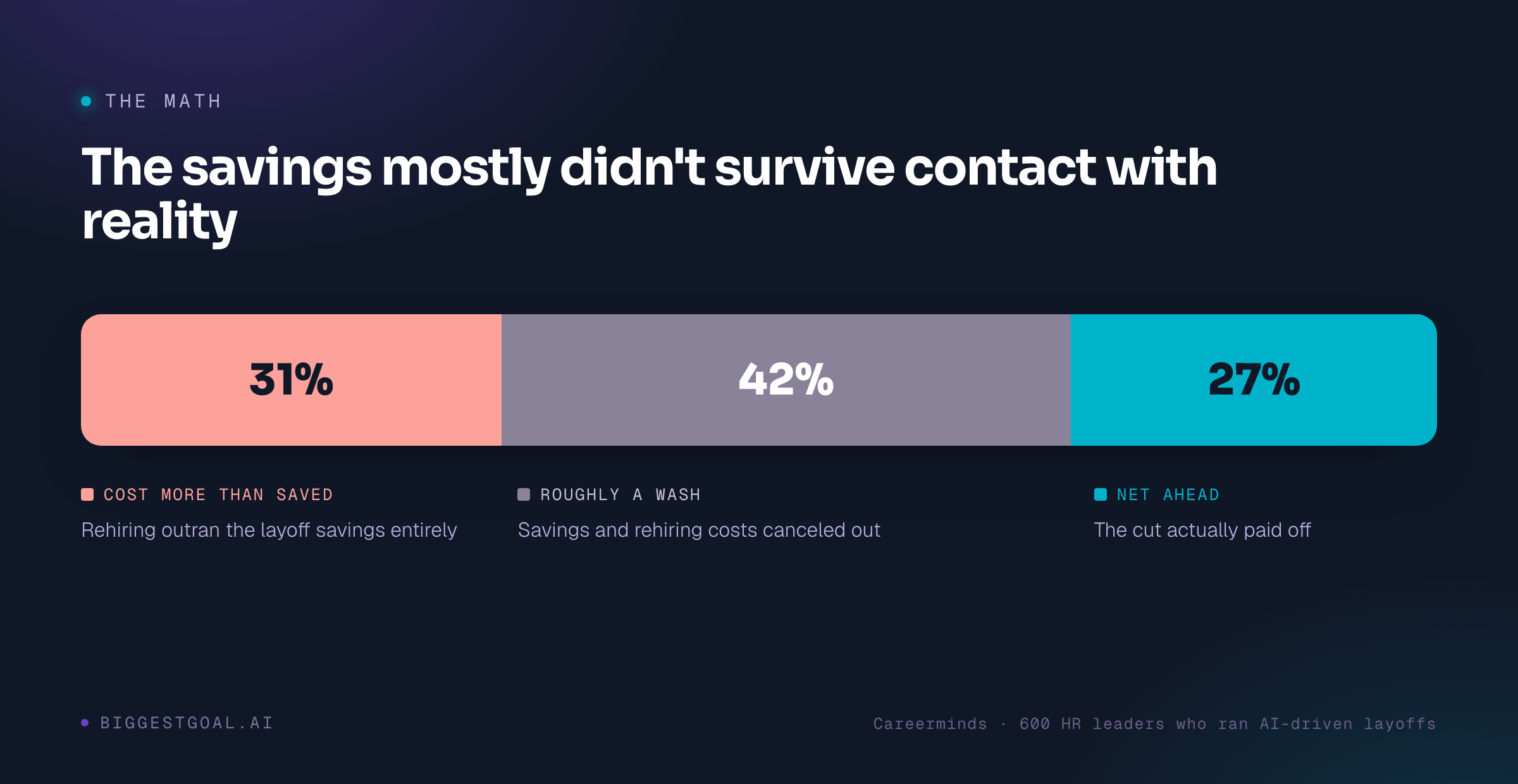
In the Careerminds data, 31% of companies said rehiring ended up costing more than the layoffs ever saved, and another 42% said the savings and the rehiring costs roughly canceled out. The math that justified the layoff mostly didn't survive contact with reality.
What actually broke
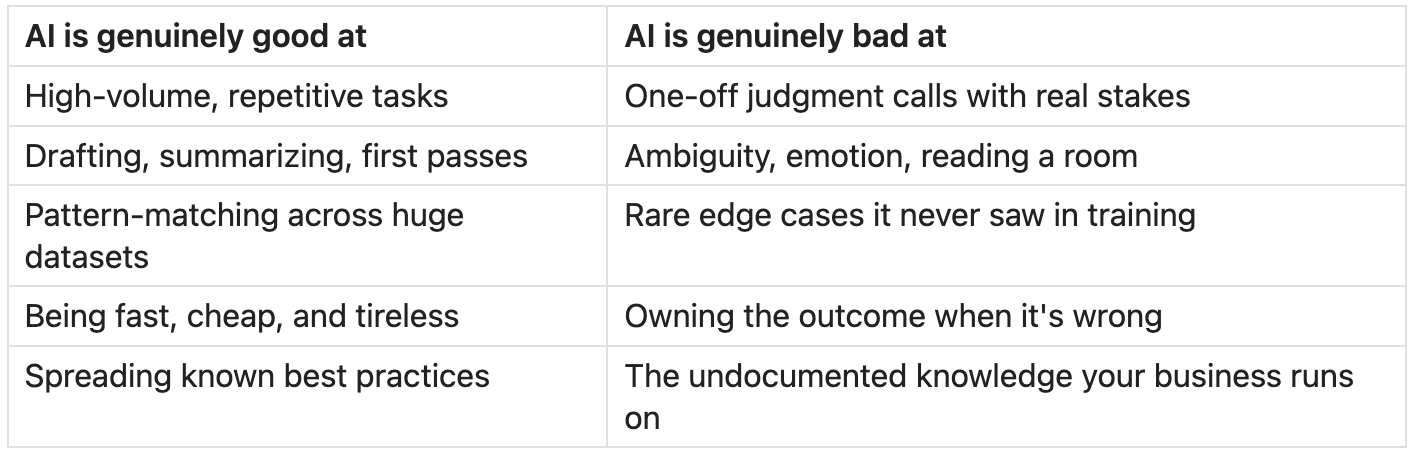
The tempting read is "the AI wasn't good enough yet." But that's mostly wrong. The models are extraordinary. What broke is the thing AI is genuinely, structurally bad at: judgment.
AI learns from data. But the knowledge that runs your business, why this customer gets an exception, which design spec is technically fine but will fail in the field, how to read a tense negotiation, was never written down.
Researchers call it tacit knowledge, and by definition, it doesn't live in any database the model can be trained on. As one Forbes analysis put it this month, AI "isn't built for ambiguity, emotion, or edge cases," and the clearest failures come from businesses that removed human judgment too early.
That's the pattern in every reversal above.
AI matched or beat humans on the routine, high-volume, well-documented middle of the work. It fell apart at the edges: the unusual case, the emotional customer, the design flaw no requirement document anticipated. And the edges are exactly where the expensive mistakes live.
People aren't perfect at judgment, but a seasoned employee brings something the model can't: accountability, context they've never articulated, and the instinct to notice when something is off even when it technically passes.
Ford didn't rehire its veterans to write more code. It rehired them to catch what the AI couldn't see.
What AI is good at, and what it isn't
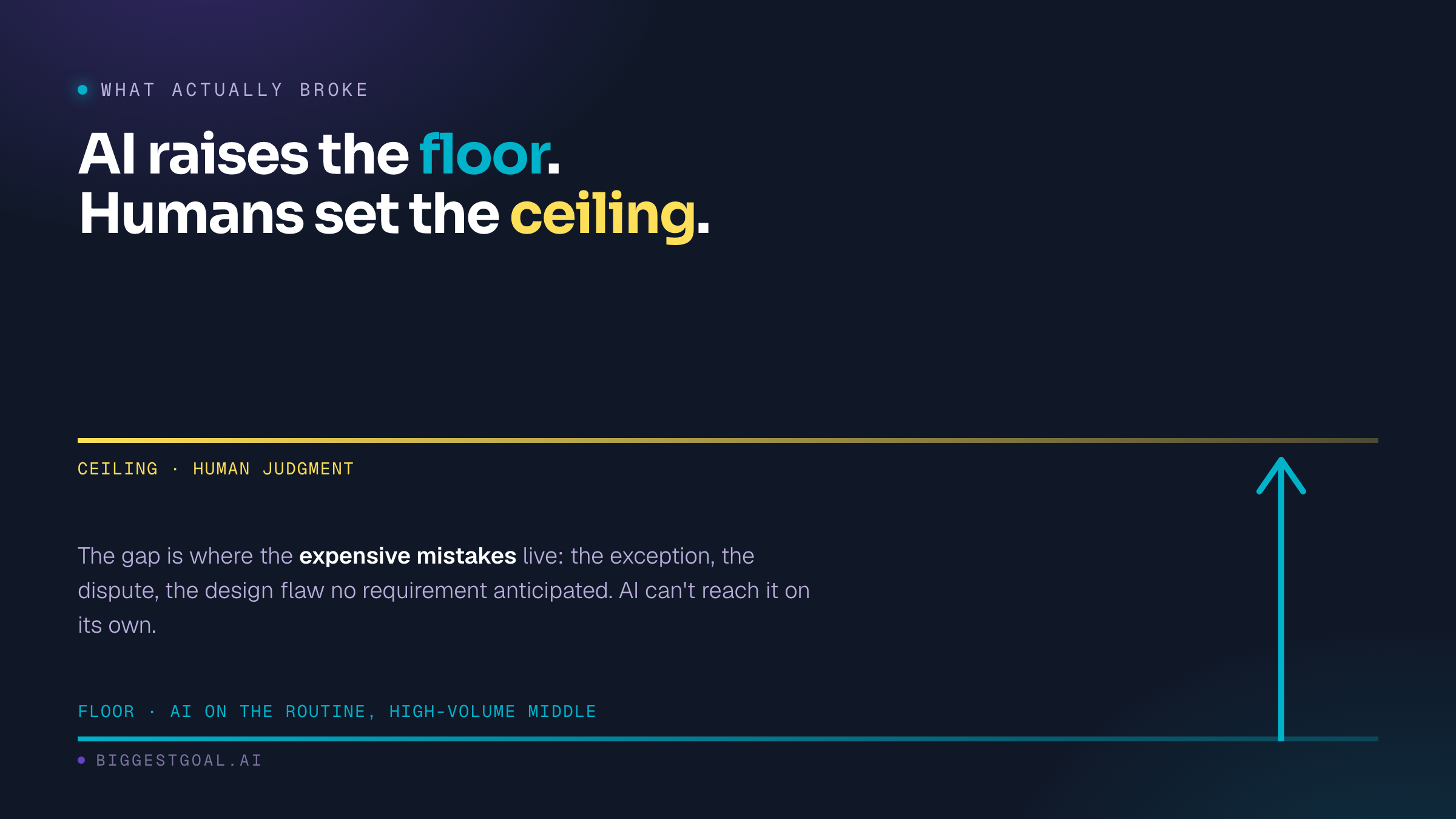
AI raises the floor of your operation, your baseline; it makes the routine faster and more consistent, but it does not raise the ceiling on its own. The ceiling is still set by human judgment. Companies that cut the humans didn't just lose hands; they lost the ceiling.
AI is a tool that amplifies people
Contrast the boomerang companies with IBM, which is probably the smartest version of this story.
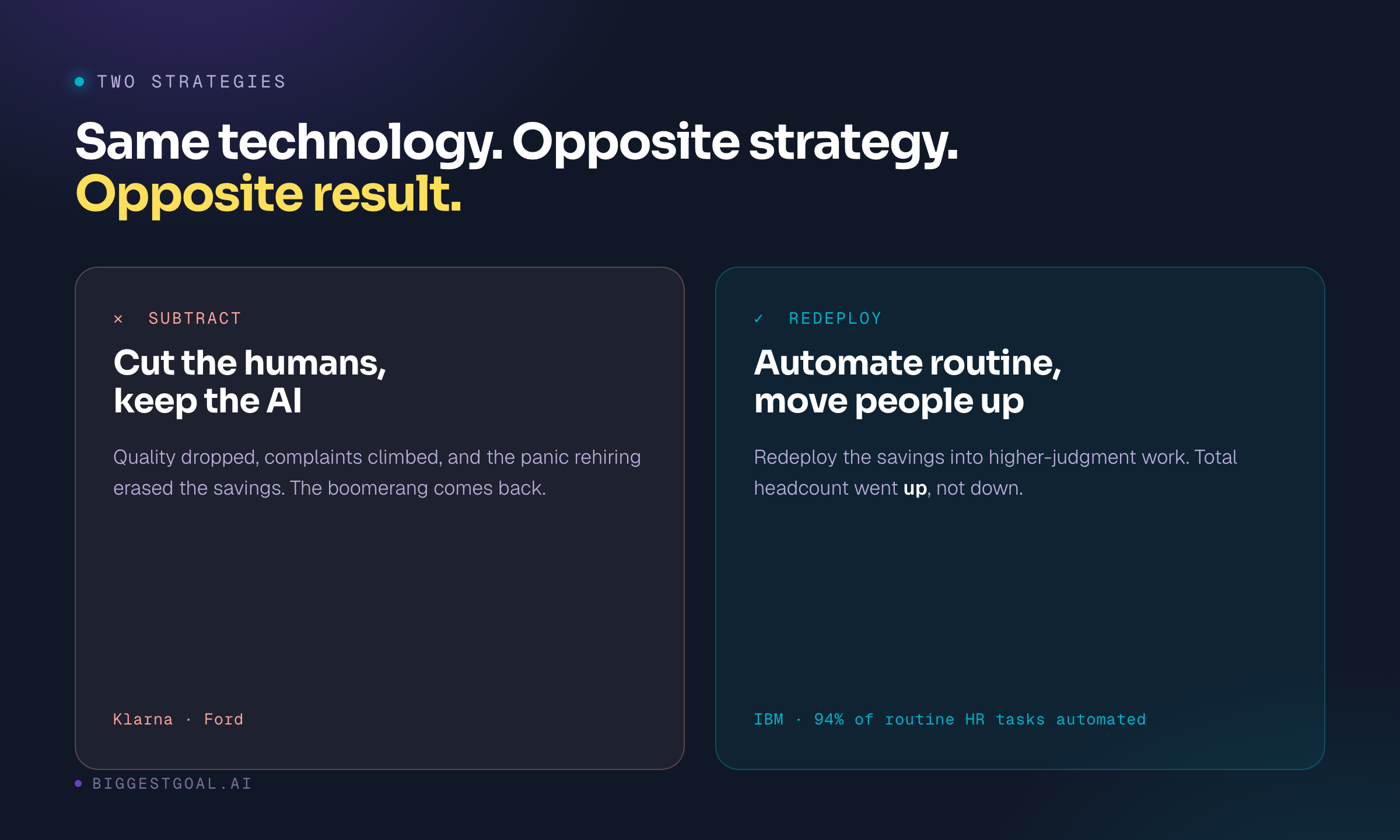
IBM automated 94% of routine HR tasks with an AI agent and did reduce its HR headcount by a few hundred. But total employment at IBM went up, not down.
CEO Arvind Krishna's explanation: automating the routine "gives you more investment to put into other areas," so they redeployed the savings into programmers and salespeople, people doing higher-judgment, higher-value work.
That's the whole game.
The companies that stumbled treated AI as a replacement and subtracted people. The companies pulling ahead treat it as a tool and redeploy people toward the work only humans can do. Same technology, opposite strategy, opposite result.
The teams that leverage AI are pulling away from everyone else
This isn't a "go slow on AI" piece. The evidence that AI-augmented teams win is just as strong as the evidence against replacement.
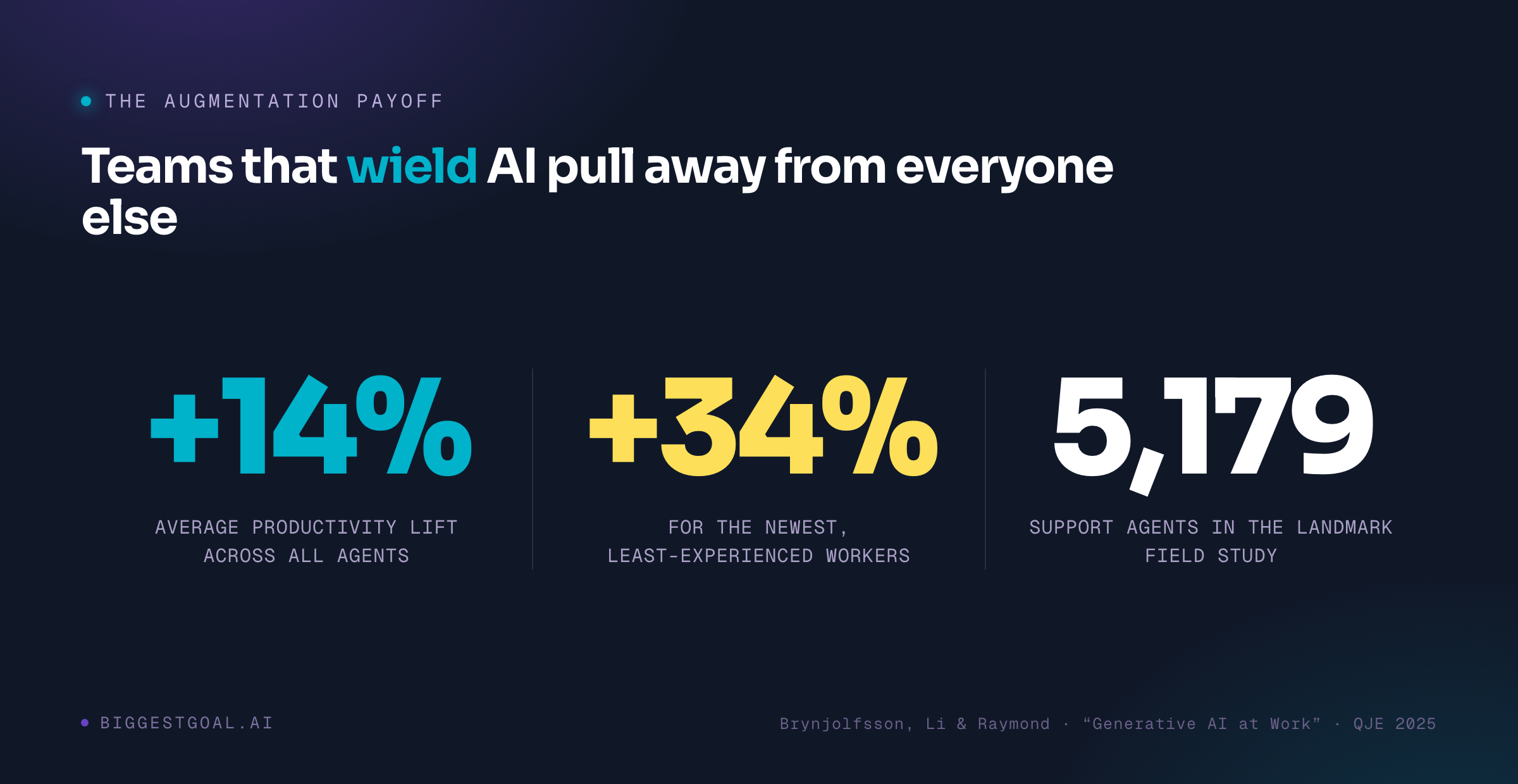
The landmark study here, by Erik Brynjolfsson (Stanford) and colleagues, tracked 5,179 customer support agents who used an AI assistant. Productivity rose 14% on average, and 34% for the newest and least-experienced workers, while barely moving the top performers. The AI worked by capturing what the best agents did and teaching it to everyone else. Customer sentiment improved, and so did employee retention.
Read that carefully, because it's the opposite of the layoff logic. AI's biggest gift isn't headcount you can cut. It's a floor you can raise: your newest people perform like veterans faster, your whole team levels up, and the humans stay to handle what the AI can't.
A team that knows how to wield AI beats a team without it, and it also beats a company that fired its team and kept only the AI.
What this means for you
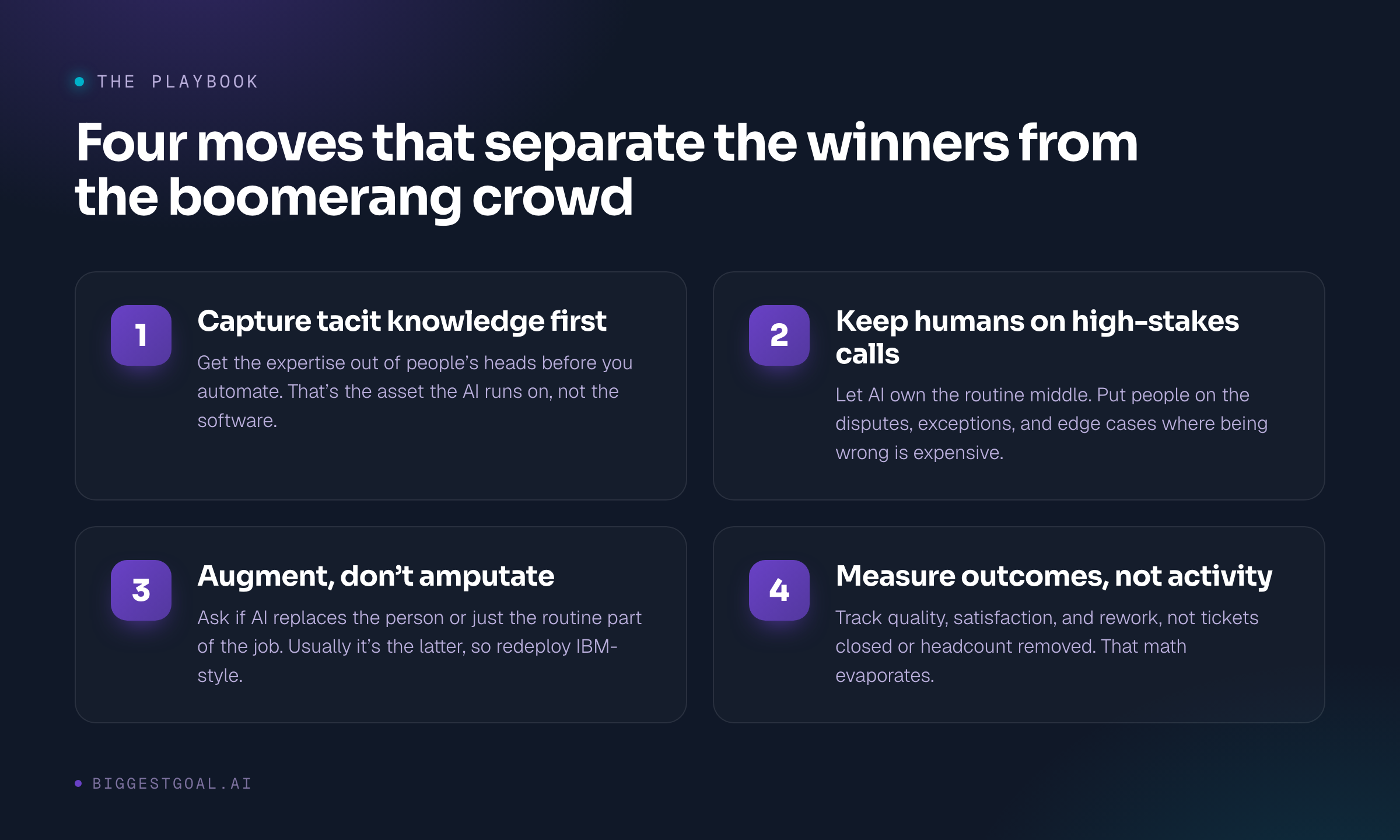
Four moves separate the winners from the boomerang crowd:
Capture the tacit knowledge before you automate anything. The reason Ford's AI failed is that the experts who could have leveraged AI had already been asked to leave. Train for judgment with AI support. That's your asset, not the software.
Keep humans on the high-cost-of-error decisions. Let AI own the routine, high-volume middle. Put people on the edges: the disputes, the exceptions, the judgment calls where being wrong is expensive. That's the hybrid model Klarna rebuilt after learning the hard way.
Augment, don't amputate. Before you cut a role, ask whether AI replaces the person or just the routine part of their job. Usually it's the latter, which means the smart move is redeploying that person to higher-value work, IBM-style, not eliminating them.
Measure outcomes, not activity. The layoffs were justified with cost savings that mostly evaporated. Track quality, customer satisfaction, and rework, not just how many tickets the bot closed or how much headcount you removed.
The lesson of the boomerang isn't "AI doesn't work." It's that AI is a power tool, and power tools make skilled people dramatically more productive and unskilled operations dramatically more dangerous. The companies rehiring in a panic bought the tool and fired the operators. The ones winning kept the operators and handed them the tool.
From Biggest Goal
If this hit close to home (you're under pressure to cut headcount for AI, or you already did and the cracks are showing), that's precisely the conversation we have every week. We help teams figure out what AI should own, what humans must keep, and how to capture the expertise that makes the AI actually work. Grab a free 30-minute session with one of our experts and we'll map it to your situation.
Know someone who'd find this useful?
Forward this to a colleague who's weighing an AI-for-headcount trade. They can subscribe at your.biggestgoal.ai to get our briefings daily.
Source notes
Ford rehiring veteran engineers: Bloomberg, Jun 25 2026 · TechCrunch, Jun 28 2026 · Forbes, Jun 30 2026
Klarna reversal: Forbes, May 18 2025 · Entrepreneur
Rehiring pattern and regret data: CNBC, Jul 1 2026 · Forbes (Forrester 55%) · Careerminds survey via HR Director · Gartner forecast via Washington Times, Mar 10 2026
IBM redeployment: Entrepreneur · People Matters
Judgment / tacit knowledge gap: Forbes (Susarla), Jun 25 2026 · IBM, "the context gap" · IDC, "the knowledge your AI may never have"
Augmentation productivity study: Brynjolfsson, Li & Raymond, "Generative AI at Work," NBER w31161 / QJE 2025