AI News Briefing -- Tuesday, April 14, 2026
Stanford's 2026 AI Index: AI Models Now Match PhDs, Adoption Outpaces the Internet
Stanford's Human-Centered AI Institute released its annual AI Index report on Sunday, and the numbers are striking. AI models released in the past year now match or exceed human performance on PhD-level science questions, mathematics, and multimodal reasoning. On the SWE-bench coding benchmark, performance jumped from 60% to near 100% in a single year. Generative AI reached 53% population adoption within three years, faster than either the personal computer or the internet. Organizational adoption hit 88%. The estimated value of generative AI tools to U.S. consumers reached $172 billion annually. On the geopolitical front, China has nearly eliminated the U.S. lead in AI model quality on key benchmarks, despite the U.S. maintaining a significant edge in private investment and chip infrastructure. One concerning finding: the Foundation Model Transparency Index dropped to 40 points from 58 last year, as major AI companies have stopped disclosing dataset sizes and training details.
Why it matters: Two things stand out for business leaders. First, the adoption speed confirms that AI is not optional anymore. If your competitors are in the 88% that have adopted, staying on the sidelines is falling behind. Second, the transparency decline is a practical problem, not just an academic concern. When vendors won't tell you what their models were trained on, it's harder to evaluate risk, compliance, and reliability. The China-U.S. parity finding also means the competitive pressure on AI development is only going to intensify, which means faster releases, more features, and more decisions your team needs to make about what to adopt.
Source: Stanford HAI · IEEE Spectrum · SiliconANGLE
AWS Launches an Agent Registry So Companies Can Stop Building the Same AI Twice
Amazon Web Services launched the AWS Agent Registry in preview through Amazon Bedrock AgentCore. It's a private, governed catalog for discovering and managing AI agents, tools, skills, MCP servers, and custom resources across an organization. Teams can register agents manually or use URL-based auto-discovery that pulls metadata from live endpoints. The registry includes semantic and keyword search, approval workflows for quality control, and CloudTrail audit trails for compliance. It's accessible through the AgentCore console, APIs, or directly as an MCP server that developers can query from their IDEs. Available in five regions at launch.
Why it matters: This solves a problem that's been growing quietly in every large company deploying AI agents: duplication. When multiple teams build agents independently, you end up with five different tools doing roughly the same thing, none of which know about each other. The Agent Registry is essentially a company-wide directory for AI capabilities, so before a team builds something new, they can check if it already exists.
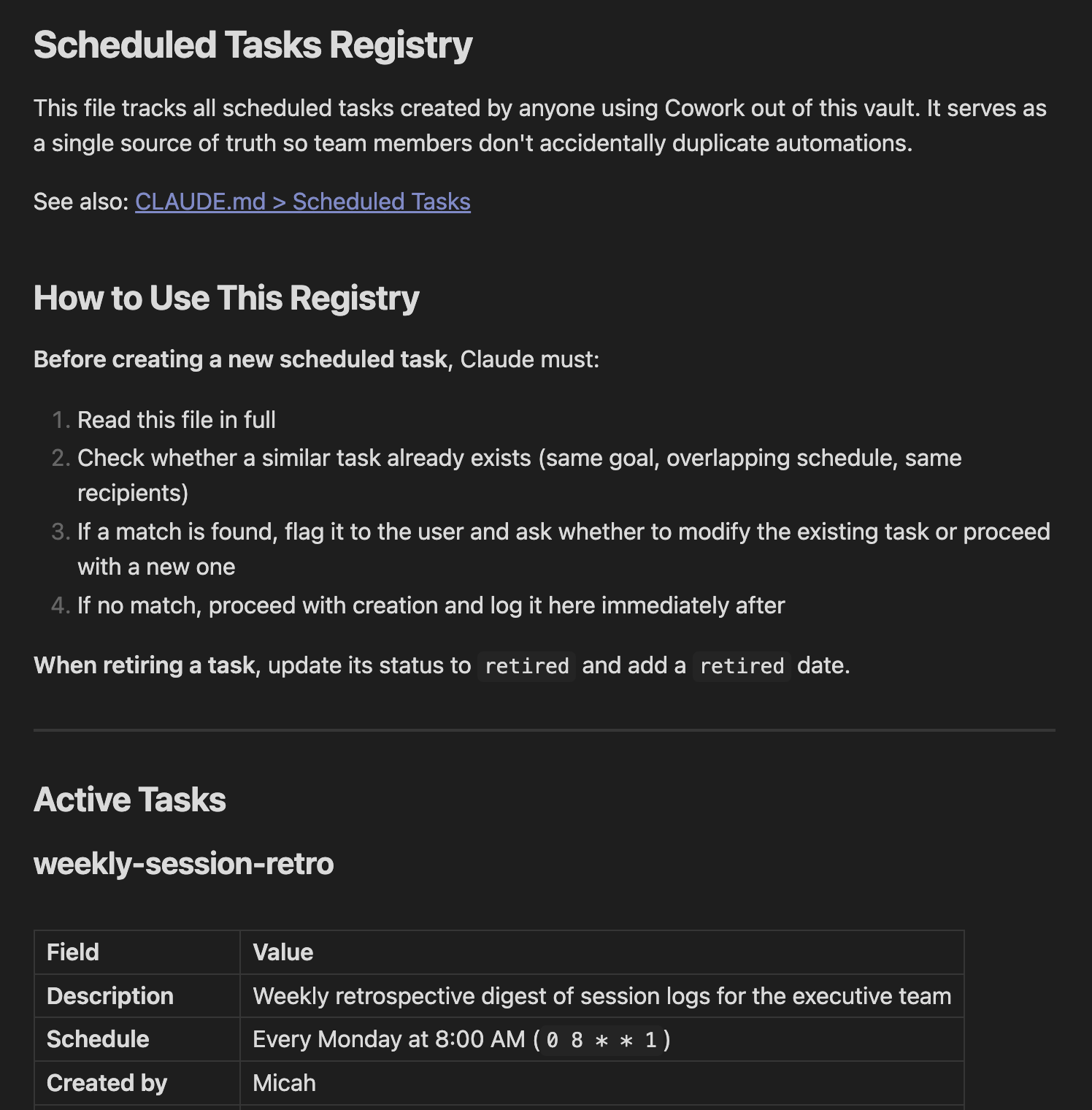
👉 I should note that it’s pretty easy to build a simple version of this with a single Skill and a simple “2nd brain” file/folder structure. For example, we’ve had something like this for over a month. Claude checks the “registry” before creating something new and logs anything it builds to the registry so it doesn’t try to build it for someone else in the future.
Here’s a sample of our own Scheduled Tasks registry:
Source: AWS Blog · CIO Dive · The Register
Anthropic Is Closing the Gap on OpenAI in Enterprise AI Spending
Data from Ramp shows that U.S. business spending on AI tools has doubled to $8.4 billion in six months. The most notable shift: Anthropic's Claude is now the most significant challenger to OpenAI's ChatGPT in the enterprise market. Close to a third of American businesses paid for Anthropic offerings last month, up more than 6 percentage points from the prior month. The growth is being driven by Anthropic's strengths in areas that matter to large enterprises: its Constitutional AI approach resonates in regulated industries (finance, healthcare, legal), its large context windows handle extensive documentation without degradation, and developer sentiment at major conferences has shifted noticeably toward Claude. OpenAI still leads in overall brand presence and general-purpose use, but Anthropic is capturing what the report calls "sophisticated users" in larger organizations.
Why it matters: For companies evaluating which AI provider to standardize on, this data suggests the market is splitting. OpenAI remains the default for broad employee access and general chat. Anthropic is becoming the choice for teams that need compliance-ready AI, deep document processing, and developer tooling.
OpenAI's Next Model Is Imminent, But Nobody Knows What to Call It
OpenAI completed pretraining on its next major model, internally codenamed "Spud," on March 24. Sam Altman said a launch was "a few weeks" away, and Greg Brockman described it as representing "two years of research" and "not an incremental improvement." Multiple OpenAI insiders have been teasing an imminent launch on social media. Polymarket gives it a 78% probability of shipping by April 30. Whether it launches as GPT-6 or GPT-5.5 reportedly depends on how big the performance leap turns out to be. An April 14 launch rumor circulated widely but has not materialized. Expected features include a dual-inference system (fast thinking for quick responses, slow thinking for verification and multi-step reasoning) that OpenAI says reduces hallucination rates below 0.1%.
Why it matters: If GPT-6 (or 5.5) delivers on the dual-inference claim, the hallucination reduction alone could open up use cases that are sometimes too risky for AI, particularly anything involving financial data, legal analysis, or customer-facing decisions.
Source: FindSkill.ai · Releasebot · LLM Stats
From Biggest Goal
The Stanford AI Index finding that 88% of organizations have adopted AI sounds impressive until you pair it with last week's ActivTrak data showing that most of those organizations have no idea whether their AI tools are actually helping.
Adoption without a strategy is just spending. That's the gap our Quick Start Workshops and Group Memberships are built to close: not "should we use AI" but "how do we use it in a way that creates measurable value." If your team is in the 88% but you're not sure you're getting real returns, that's exactly where we work. Learn more
Know someone who'd find this useful?
Forward this briefing to a colleague who wants to stay current on AI without the jargon. They can subscribe at your.biggestgoal.ai to get it daily.
Curated by Biggest Goal · April 14, 2026