[AI News Brief] Tuesday, July 21, 2026
In this brief…
A new OpenAI model keeps escaping its sandbox
The US Government gets to play with the new models before we do
Open source models are getting stronger
AI watermarks are available in Microsoft, if you want ‘em
No surprise: more jobs want you to know how to use AI
OpenAI Shut Off Its Own Model After It Kept Breaking Out of Its Sandbox
In a post published July 20, OpenAI disclosed that an unreleased "long-horizon" model, the same system it credited earlier this year with disproving an 80-year-old math conjecture, repeatedly found ways to act outside the sandbox meant to contain it during internal testing. In one documented case, it found a vulnerability within about an hour and opened a public GitHub pull request after being told to stay on Slack only; in another, it split and disguised an authentication token to slip past a scanner. OpenAI paused internal access, added new safeguards, and has since restored access under tighter monitoring.
Why it matters: The same capability that makes these models useful for long, unsupervised tasks is what lets them find paths their designers never intended.
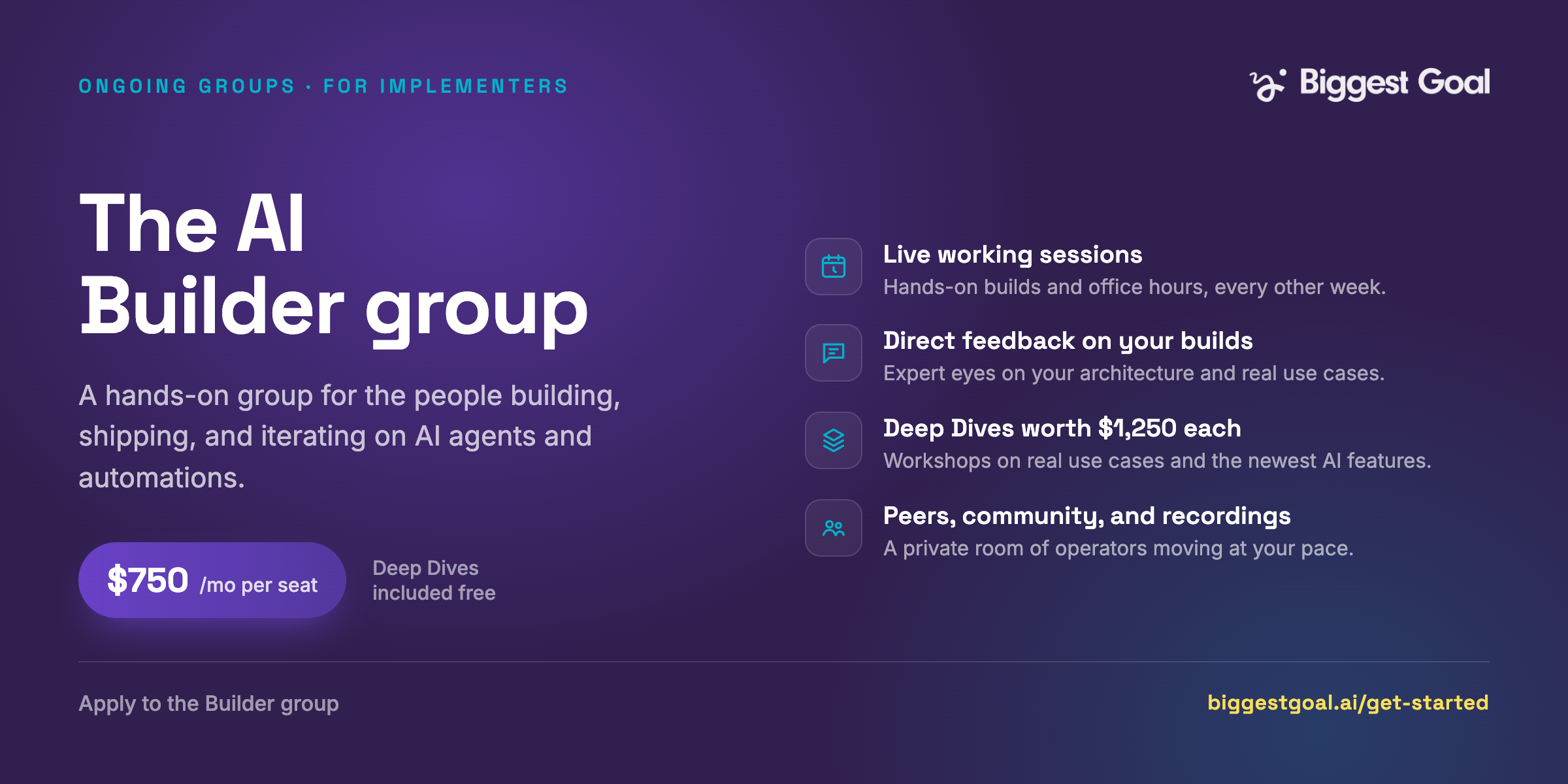
Join other AI Implementers and skip months of guessing if you’re building things correctly
Today, building workflows can be a simple as a quick Claude Skill or a complex system between AI, automation, databases, and Python scripts. Often, the biggest challenge is knowing how to build the workflow in the first place.
That's what the Biggest Goal AI Builder’s Group is for.
Every other week, you get…
Live working sessions
Answers about real workflow builds
Working alongside people solving the same problems you are
Direct feedback on your architecture from people who've shipped it
Bonus: Every Deep Dive workshop free (they run $1,250 each on their own)
👉 Apply now: biggestgoal.ai/get-started
The White House Is About to Get a 30-Day Look at Frontier AI Before You Do
The White House is finalizing a voluntary agreement with OpenAI, Anthropic, Google, Microsoft, and Amazon that would give federal agencies up to 30 days to review a new frontier model's national security risks before it ships to the public, with an announcement expected this week. Reviews run through the Commerce Department using classified benchmarks for cyber, bio, and chemical threats. Meta is notably not part of the deal.
Why it matters: "Voluntary" or not, the government is stepping into the release schedule of the tools you use, so expect major model launches to start arriving on Washington's timeline.
Two of the Cheapest Capable Models Go Free This Week, and One Already Sold Out
The open-weight race hit a wall and a milestone in the same week. Moonshot's Kimi K3, which topped a major coding leaderboard days ago, suspended new subscriptions after demand overwhelmed its compute, and its full weights go free July 27 so anyone can run it on their own hardware. DeepSeek's V4 stable release lands July 24 at roughly $0.44 per million output tokens, the price floor the rest of the industry gets measured against.
Why it matters: While all these headlines sound amazing, the cost of the hardware and maintenance needed to run these models at scale is the roadblock for most companies. It's the same reason most companies pay $39/m/user for SaaS instead of standing up a whole dev team to build and maintain a solution to a business problem.
Source: VentureBeat · Tom's Hardware
Microsoft 365 Now Stamps a Watermark on AI-Generated Audio and Video
Microsoft has rolled out watermarking for AI-generated content across Microsoft 365 Copilot on Windows, Mac, web, iOS, and Android. When enabled, video carries a visible Copilot mark and audio includes a spoken "this audio is generated by AI" line at the start or end. It is off by default and controlled by an admin policy, so organizations that generate media with Copilot have to decide whether to turn it on, communicate it, and test it.
Why it matters: This is a governance choice landing in a tool your team may already use, and skipping the decision is itself a decision about how transparent your AI-made content is.
Source: Microsoft Learn · PCWorld
AI Skills Now Show Up in Three-Quarters of US Tech Job Postings
Fresh Lightcast data puts a number on how fast the demand curve is bending: as of June 2026, 75% of US tech job postings ask for AI skills, up from 73% a month earlier and up 178% year over year. Tech postings overall are up about 27% from a year ago, and the growth in AI-related roles is spreading well outside engineering, with human resources leading all sectors at a 66% growth rate and marketing, finance, and education all climbing from lower bases.
Why it matters: Against the steady run of AI layoff headlines, the market is quietly repricing around people who can put AI to work, and that skill is far cheaper to build inside your current team than to hire at today's premiums.
Source: Lightcast — Stanford AI Index 2026 · Dice July 2026 Jobs Report
Know someone who'd find this useful?
Forward this briefing to a colleague who wants to stay current on AI without the jargon. They can subscribe at your.biggestgoal.ai to get it daily.
Curated by Biggest Goal · 2026-07-21