[AI News Brief] Friday, July 31, 2026
In this brief…
OpenAI makes drastic pricing cuts
Google fixes a record number of bugs in Chrome
Surprise, surprise… using AI poorly means wasted money
Employers want AI-skilled workers, but most workers aren’t
Plus, two ways to become more skilled with AI
OpenAI Cut One Model's Price by 80% Yesterday. DeepSeek Shipped a Rival for 14 Cents.
OpenAI dropped API prices again on Thursday: GPT-5.6 Luna now costs 80% less and GPT-5.6 Terra 20% less, putting Terra at $2 per million input tokens and Luna at $0.20. The company also replaced its Priority Processing tier with a Fast mode that runs up to 2.5 times faster at double the price. On the same day, DeepSeek pushed V4-Flash-0731 into public beta at $0.14 per million input tokens and $0.28 output, with a jump on agentic benchmarks from 61.8 to 82.7 on Terminal Bench 2.1.
Why it matters: Pricing for frontier models is still all over the board. Global competition, open source/weight models, and continued improvements in capabilities makes it hard to predict whether pricing will settle any time soon.
Source: OpenAI API changelog · DeepSeek V4-Flash analysis · OfficeChai
Six in Ten Employers Want AI-Native Workers. Only 14% of Workers Say They Are One.
Indeed surveyed 1,001 job seekers and 300 employers and published the findings Tuesday. Nearly 60% of employers now want people who use AI to produce their actual work output, while just 14% of employees describe themselves as AI natives. Fewer than half of all workers say they get the AI training they need, compared with more than three-quarters of workers who already qualify as AI natives. Only 32% say they have had proper training for the job they currently hold. A quarter named accuracy, ethics, and privacy concerns as the main thing keeping them from using AI more.
Why it matters: Indeed's own talent strategy adviser says hiring your way out of this gap will not work because the outside supply does not exist, which leaves training the people already on your payroll as the only lever.
Source: CIO Dive · Indeed report
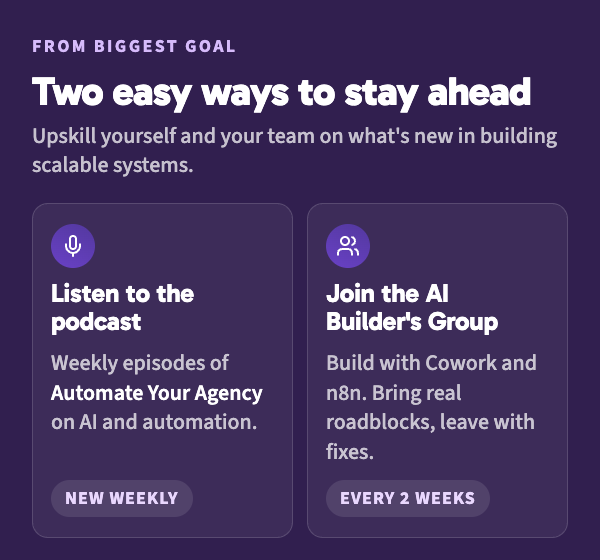
If you want to upskill yourself or get an easy way for your internal team staying up to date on what’s new in building scalable systems, here are a two easy ways:
We release weekly episodes of “Automate Your Agency” to help you stay up to date on the latest tech and trends with AI and automation as it relates to building scalable businesses.
Apply to join the AI Builder’s Group
We meet every other week in a virtual group call. Get support and learn how to build with tools like Cowork and n8n. Bring your questions, ideas, and roadblocks to get them refined and resolved in real time. (Bonus: All group members get access to 100% of our Deep Dive Workshops - $1250+ in value)
Google Fixed 1,072 Chrome Security Bugs in Two Releases, Beating the Previous 23 Combined
Google said this week that AI tooling helped it patch 1,072 security bugs across the two Chrome versions shipped in June, more than the 1,036 fixes in the previous 23 versions released over roughly two years. Large language models are now used across the whole vulnerability pipeline: finding flaws, reproducing bug reports, judging severity, routing them to the right developer, drafting candidate patches, and writing the tests. One flaw the system surfaced was a sandbox escape that had been sitting in the codebase for more than 13 years.
Why it matters: Google got these numbers by applying AI steps in a process it had already documented, not by shoving everything into AI and expecting the same result.
Source: TechCrunch · Google blog · BleepingComputer
A Quarter of Every AI Dollar Is Wasted, and Half of Companies Cannot Name Who Owns the Bill
Harness surveyed 700 FinOps and engineering leaders and published the results Wednesday: roughly one in four dollars spent on AI is waste. More than half of organizations have no single owner for AI costs, only one in five can trace an unexpected spike to its source within hours, over half forecast AI spend by guesswork rather than data, and more than 40% still manage it in spreadsheets. The report points to copilots and coding assistants as one of the biggest cost drivers precisely because they arrive looking like ordinary software licenses instead of infrastructure.
Why it matters: If you’re not programmatically defining how and where you use AI, your results are based on prompts and processes/Skills, then yes, it’s going to constantly reinvent the wheel and spend more tokens/usage than you probably want it to. The answer is to build systems, and use AI in the correct areas, not as a blanket solution to everything.
Source: CIO Dive · Harness report
Know someone who'd find this useful?
Forward this briefing to a colleague who wants to stay current on AI without the jargon. They can subscribe at your.biggestgoal.ai to get it daily.
Curated by Biggest Goal · 2026-07-31