[AI News Brief] AI Makes Everyone a Manager Now
Glean's new Work AI Index (6,000 full-time knowledge workers, co-authored with researchers at Stanford, UC Berkeley, and Harvard) found 87% of workers use AI, 75% feel more productive, but only 13% say AI has significantly improved their company's performance.
(Keep reading because this 13% stat is actually a huge improvement!)
If you don't read anything else in this article, read this!
I want to highlight some stats that you absolutely must understand.
According to the report, Glean's "transformative" organizations (the ones seeing real business results) don't outperform everyone else. They out-manage them:
90% of their people say the company provides enough AI training and support, vs 52% everywhere else.
84% say the company formally rewards AI skills, vs 48%.
90% say leadership treats AI as a chance to redesign how work gets done, vs 54%.
They invested in the human side of the equation: context, training, a clear quality bar, and recognition for the people who manage AI well.
Everyone is a manager now (and likely a very untrained one)
A year ago, most of your team did the work themselves. They wrote the doc, built the deck, pulled the numbers, answered the email. Today they do something different: they hand the work to something else, wait, and decide whether what comes back is good enough to ship.
Technically, that's "using a tool." But that is also "managing." And almost no one on your team was trained to do it.
This is the real story behind the report, and it reframes the whole "is AI actually working?" question.
These tools turned everyone into a power user and simultaneously into a first-time manager of a fast, tireless, occasionally confidently wrong direct report (but “confidently wrong" is exactly like managing a normal team member, LOL).
Some people are managing it well. Most are winging it.
The trend is what matters.
The report says that only 13% of those interviewed claim that AI has significantly improved their company's performance.
And it's easy to read that 13% as a failure, but it's actually the needle starting to move.
Rewind 12 months, and most companies couldn't point to any measurable return. MIT's widely cited research found that 95% of enterprise generative AI pilots showed no measurable financial impact, and surveys found that a majority of CEOs reported zero revenue or cost benefit.
Look at the number again: 13% reporting significant company-level improvement is a massive improvement from 0%.
The same pattern exists at the individual level. Workers now report saving around 11 hours a week with AI. A year or so ago, Federal Reserve research put the average closer to 2 hours per week, with only heavy daily users hitting 4+ hours.
Both of those stats are going up, and not just because the models improved. What changed is tools like Cowork, the capabilities surrounding the models, and how people use them. It’s directly related to how much context they feed them and whether the organization set up the work properly.
The upside is increasingly a function of operating skill, not raw model capability.
The self-inflicted tax: botsitting
Which brings us to another interesting number in the report.
Those same workers spend about 6.4 hours a week "botsitting": feeding the AI context it didn't have to start with, checking its output, correcting mistakes, re-running prompts, and stitching together disconnected tools.
The instinct is to blame the tool, but the data says otherwise. Botsitting is overwhelmingly what happens when the work is poorly set up.
53% of workers say the information they actually need isn't even accessible to their AI.
That isn't the model being dumb.
It's people asking for good work without ever giving the AI what it needs to produce it. If your systems are set up right, you don't have to botsit as much. The babysitting is the bill for skipping the setup. 10 years ago, this was called "technical debt," it's the extra work you have to do when taking initial shortcuts.
Context-rich vs context-poor
Split results by whether AI had good access to company context, and the difference is clear:
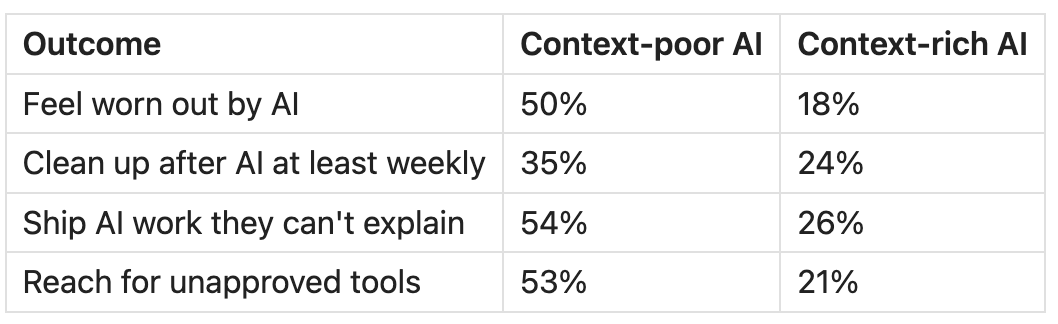
Same models used. The only variable is whether someone bothered to give the AI the context it needed.
With the right context, the quality failures roughly halve, burnout drops by almost two-thirds, and the weekly cleanup shrinks.
The “fixing-afterward” problem mostly disappears when you move the effort to the front. And if you take AI out of the equation and look at how to manage a human team, you probably won't be surprised that the same thing happens.
This is really a management story
When you delegate a task to a person, you don't get the time back for free. A good hire saves you X hours by doing the work, but you spend Y hours briefing them, answering questions, and refining the result to your standard before it goes out.
Your real gain is the time saved (X) minus the time it takes to delegate and refine (Y).
And every experienced manager knows the secret to shrinking Y: spend time up front. Give a clear brief, show an example of what good looks like, set the bar before the work starts. Under-brief someone, and you'll spend the week rewriting their output.
Using AI runs on the exact same equation.
The 11 hours is your X. The 6.4 hours of botsitting is your Y. And just like with people, the size of Y is set almost entirely by the quality of the brief and the context you provide. The context-rich vs context-poor table above is simply the difference between a good manager's setup and a bad one's.
A huge share of the workforce got promoted to manager overnight, with direct reports they never asked for and no training in how to delegate.
This isn't a fringe observation. Forbes ran a piece this month titled "When Everyone Becomes a Manager." Ethan Mollick calls management "the AI superpower." Deloitte's 2026 enterprise survey now ranks insufficient worker skills as the single biggest barrier to AI, ahead of cost, governance, and the technology itself.
The 69% who admit to "botshitting" (shipping AI work they haven't verified or can't fully explain), looks a lot less like a character flaw once you see it through this lens: It's what a brand-new manager does when they rubber-stamp a report's work without reading it, because they were never taught that reviewing is the job.
Research found that people who fully handed tasks to AI finished fastest but learned the least, while those who directed and questioned it did far better on later work they had to do alone.
Pure handoff is fast and hollow. Managed handoff teaches.
What you need to do
The opportunity in front of every leadership team isn't "get more AI." It's "teach your people to manage."
Here are four moves you can start implementing immediately:
Supply context once, not every session. Build the "brain of context files" tools like Cowork can work in. Add durable briefs, examples, and "what good looks like" references the AI can draw on, so people stop retyping the same background every day. That's where the 6.4 hours goes to die.
Teach the brief. Setting clear intent and a quality bar before the work starts is a learnable skill, and it's the biggest single lever on net savings.
Make 'reviewing' part of the job. Botsitting is a missing checkpoint, not a bad employee. Build verification into the workflow as a normal, expected step.
Reward the best managers, not the heaviest users. Usage is a vanity metric. The people who get clean, trustworthy output with the least rework are the ones to study and promote.
This is how 13% gains become 30%, and it's exactly the gap we exist to close: not teaching people to prompt, but teaching them to manage.
Source notes
Glean Work AI Index 2026: Business Wire, Jun 10 2026 · Glean report page · CIO.com on botsitting
"Going up" baselines: MIT GenAI pilot ROI research and CEO ROI surveys; earlier per-worker time-savings figures via St. Louis Fed. Note: Glean's index is inaugural this year, so the trend is drawn from comparable prior-year sources rather than a prior Glean number.
"Everyone becomes a manager": Forbes, Jun 2 2026 · Ethan Mollick, "Management as AI superpower"
Worker skills as #1 barrier: Deloitte 2026 State of AI in the Enterprise (via TechTimes)