[AI Deep Dive] You Should Be Using Claude Opus 5
Anthropic released Claude Opus 5 last Friday. It's the same price as Opus 4.8, but it has nearly 2x the performance.
The Claude product line
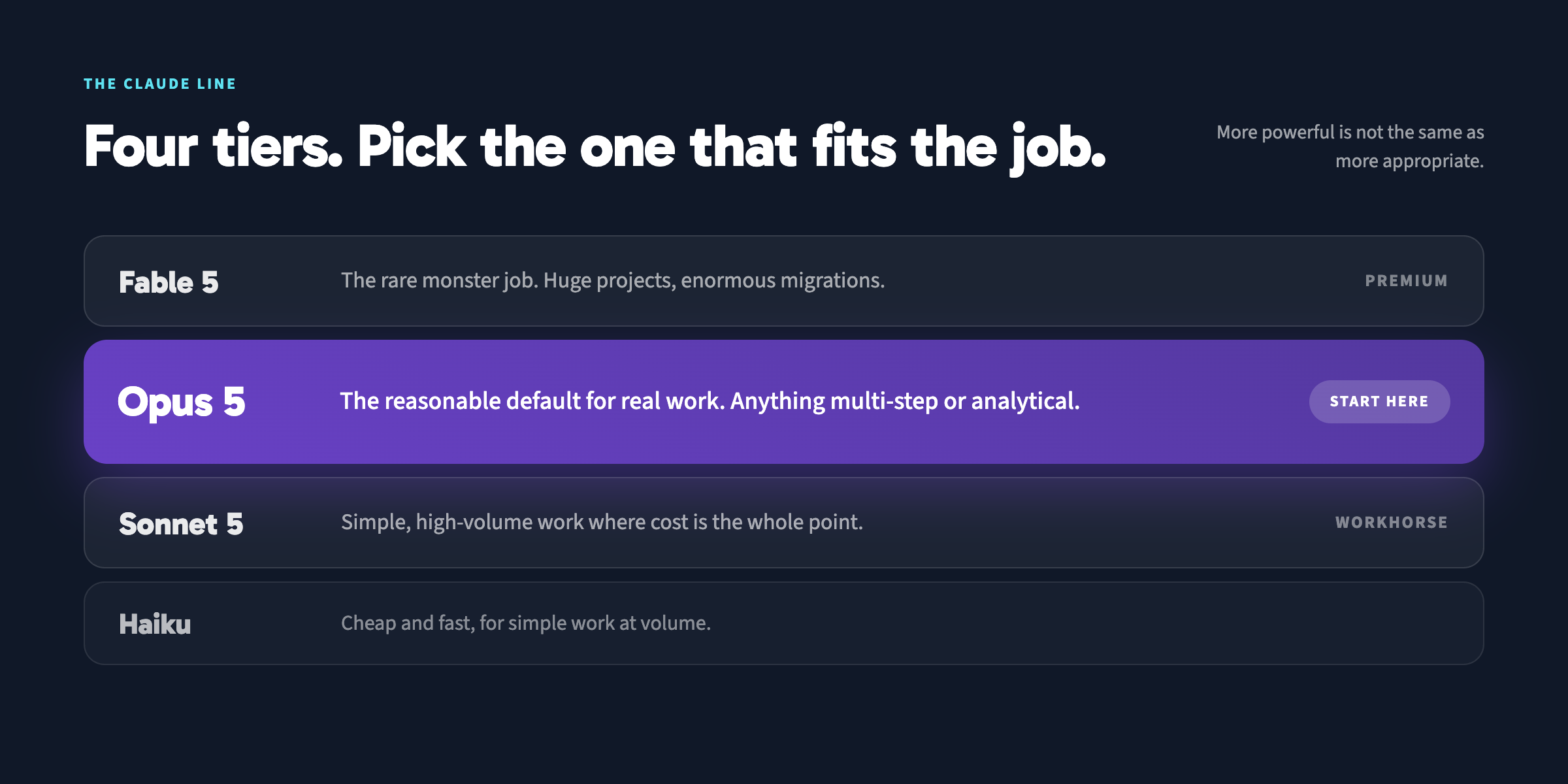
We covered this in the Fable write-up, so this is the short version. "Claude" isn't one thing. It's a family of models at different levels of power, speed, and cost, and you pick the one that fits the job.
Haiku is cheap and fast, for simple work at volume. Sonnet is the everyday workhorse. Opus is the heavy tier for hard problems. Fable sits above Opus as the most capable model Anthropic sells to the public (and Fable is priced accordingly).
The rule has always been that more powerful is not the same as more appropriate. Bigger models cost more and run slower, so the work is in matching the model to the task.
Opus 5 creates a bit of a grey area around this concept. It pulls a lot of Fable's capability down into Opus-level pricing.
What actually changed
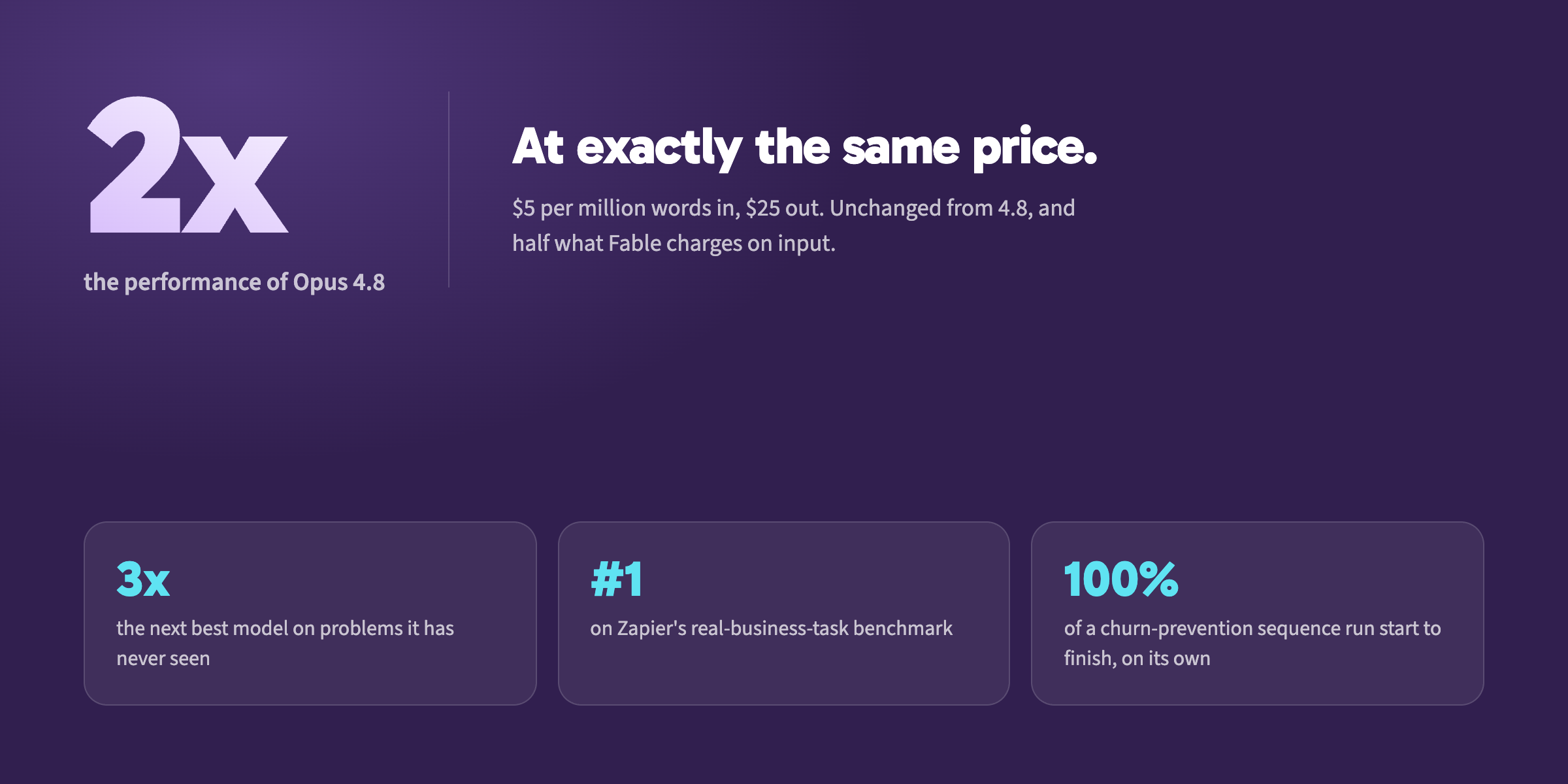
Opus 5 costs the same as Opus 4.8 did: $5 per million words in, $25 per million out. That's half what Fable charges on input.
On a hard software engineering test, Opus 5 more than doubled the old Opus score while spending less per task.
On a test built around problems the model has never seen before, it scored about three times the next best model on the market.
On Zapier's benchmark for finishing real business tasks start to finish, it took the top spot, and even at its lowest effort setting it completed more tasks than any other model.
A few impressive examples from the launch...
Anthropic gave it a mechanical drawing and asked it to rebuild the part as a 3D model in code, then deliberately took away its ability to look at the drawing. Opus 5 wrote its own image-processing code to pull the geometry out of the raw pixels, then built the part. It did this repeatedly. No competing model solved it in five tries.
Given a real bug in a widely used developer tool, it traced the actual cause and fixed an edge case the human maintainers had missed. A rival model patched the visible symptom and declared victory.
Zapier's CEO said it took a raw account-health spreadsheet and ran an entire churn-prevention sequence on its own: flagged the at-risk accounts, alerted the right owner, summarized it for the retention team. Earlier models failed the task outright. This one went 100%.
The through-line in nearly every tester report was reasoning. It "thinks" before it writes. It catches its own bad reasoning during planning, instead of after it has built the wrong thing.
One engineer described proposing a design, having Opus 5 push back, insisting, and watching it hold its position, explain which part of the idea was worth keeping, and offer a compromise.
The setting that controls your bill
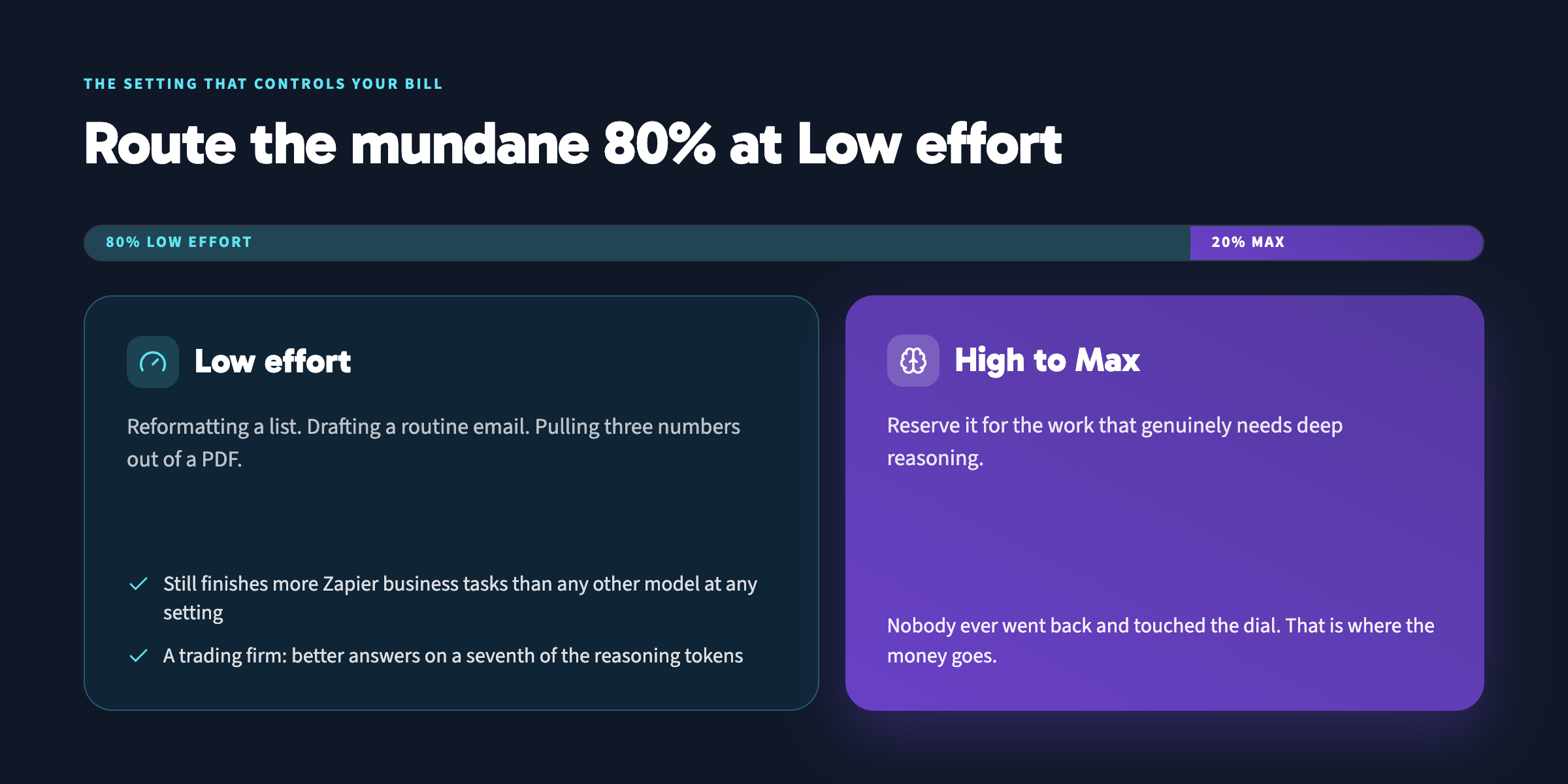
Like 4.8, Opus 5 has an effort setting. You can dial it from low all the way up to max. Low is cheap and quick. Max spends real money (read: usage) "thinking."
So the dial isn't the news. What's new is that the low end finally got good enough to trust.
That's the part that changes how you'd use it. On 4.8, turning the effort down meant accepting worse work, so most people left it high and quietly ate the cost. Opus 5 breaks that tradeoff:
At its lowest setting, it still finishes more of Zapier's business tasks than any other model at any setting.
A legal team held output quality flat while using 26% fewer tokens than 4.8 at max reasoning.
A trading firm got better answers on its own benchmark using roughly a seventh of the reasoning tokens and under half the latency of 4.8.
Now think about what your team actually runs through AI (or should be using AI for) in a week. Reformatting a list. Drafting a routine email. Pulling three numbers out of a PDF. None of that needs a model's deepest reasoning, and plenty of teams are paying for it anyway, because nobody ever went back and touched the dial.
So that's the key with Opus 5. Send the 80% (the mundane work) through as Low Effort (cheap), and reserve the expensive setting (High to Max Effort) for the work that needs it (the other 20%).
Anthropic's own charts show Opus 5 beating every other model at any given cost across effort levels, and on some tasks its floor still beats rivals at their ceiling.
There's also a Fast mode that runs about two and a half times quicker for double the price, for the times when the clock costs more than the tokens.
Your default probably changed
Opus 5 is now the default on Claude Max and the strongest option on Pro, so if you're on either plan you may already be using it without knowing. It's live everywhere: the app, Claude Code, Cowork, the API, plus Bedrock, Google Cloud, and Microsoft Foundry.
For most teams, that possibly changes the answer to "which model do we use?"
Sonnet 5 still makes sense for simple, high-volume work where cost is the whole point.
Opus 5 becomes the reasonable default for real work, especially anything multi-step or analytical.
Fable 5 stays parked for the rare monster job, the huge project or the enormous migration, where its extra ceiling is worth the premium costs.
Where it earns its money
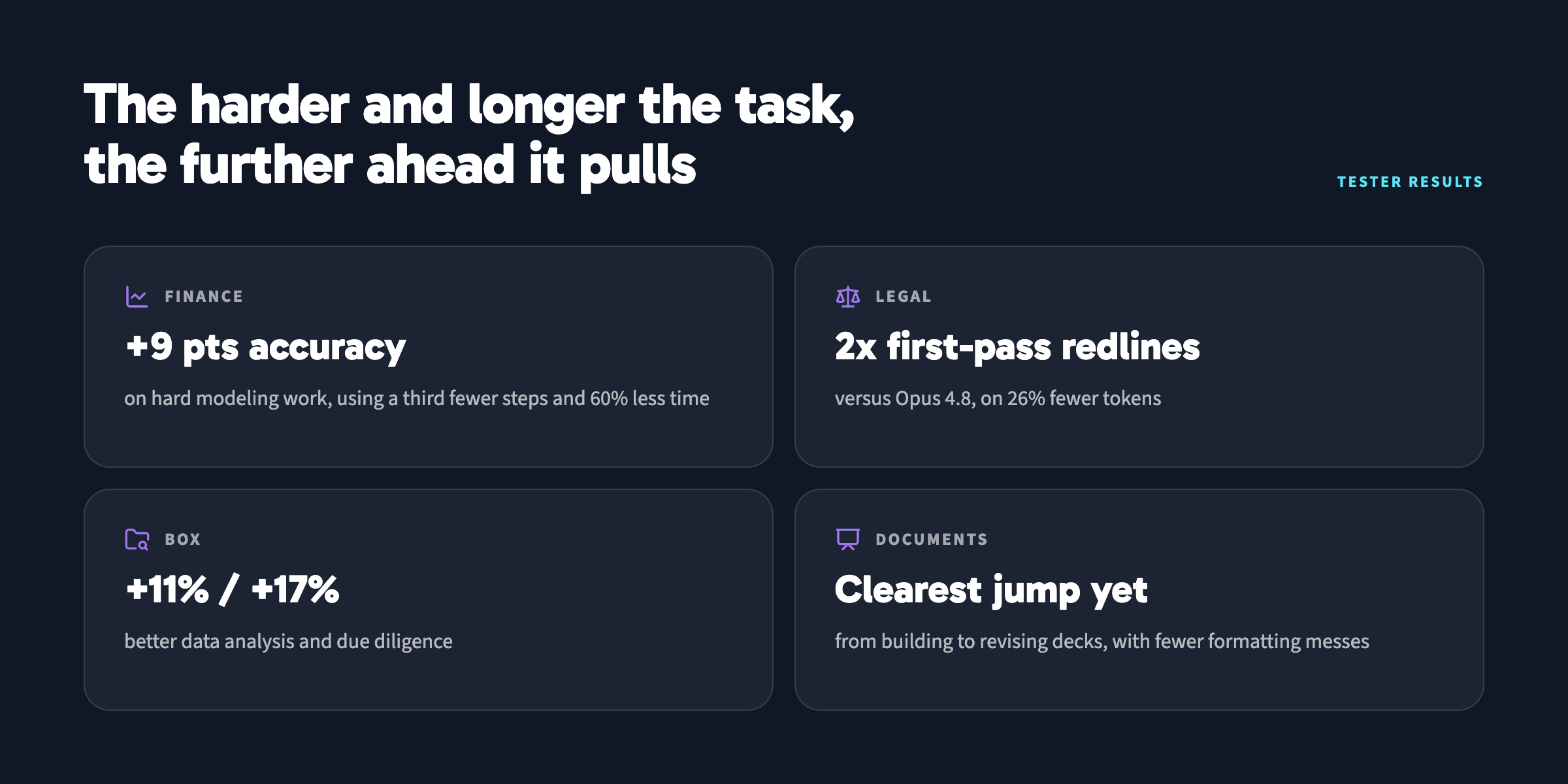
For Opus 5, the pattern across very different industries was the same: the harder and longer the task, the further ahead it pulls.
Finance testers running hard modeling work reported around 9 percentage points more accuracy while using a third fewer steps and 60% less time.
A legal team measured first-pass contract redlines at nearly double the old Opus (4.8), using 26% fewer tokens.
Box saw 11% better data analysis and 17% better due diligence.
A trading firm's engineer built a market data feed for a new exchange in one sitting, something previous models couldn't finish even with a detailed plan handed to them, and when Opus 5 found no live feed to test against, it built its own test harness.
On longer work, it holds the thread.
One tester handed it a chief-of-staff role over their development systems for a weekend, and it built its own monitoring, ran the machines, and surfaced only the decisions that needed a human.
For anyone making documents for a living, testers called it the clearest jump they'd seen from building to revising things like full decks, with better visual judgment and fewer formatting messes.
Where it isn't the answer
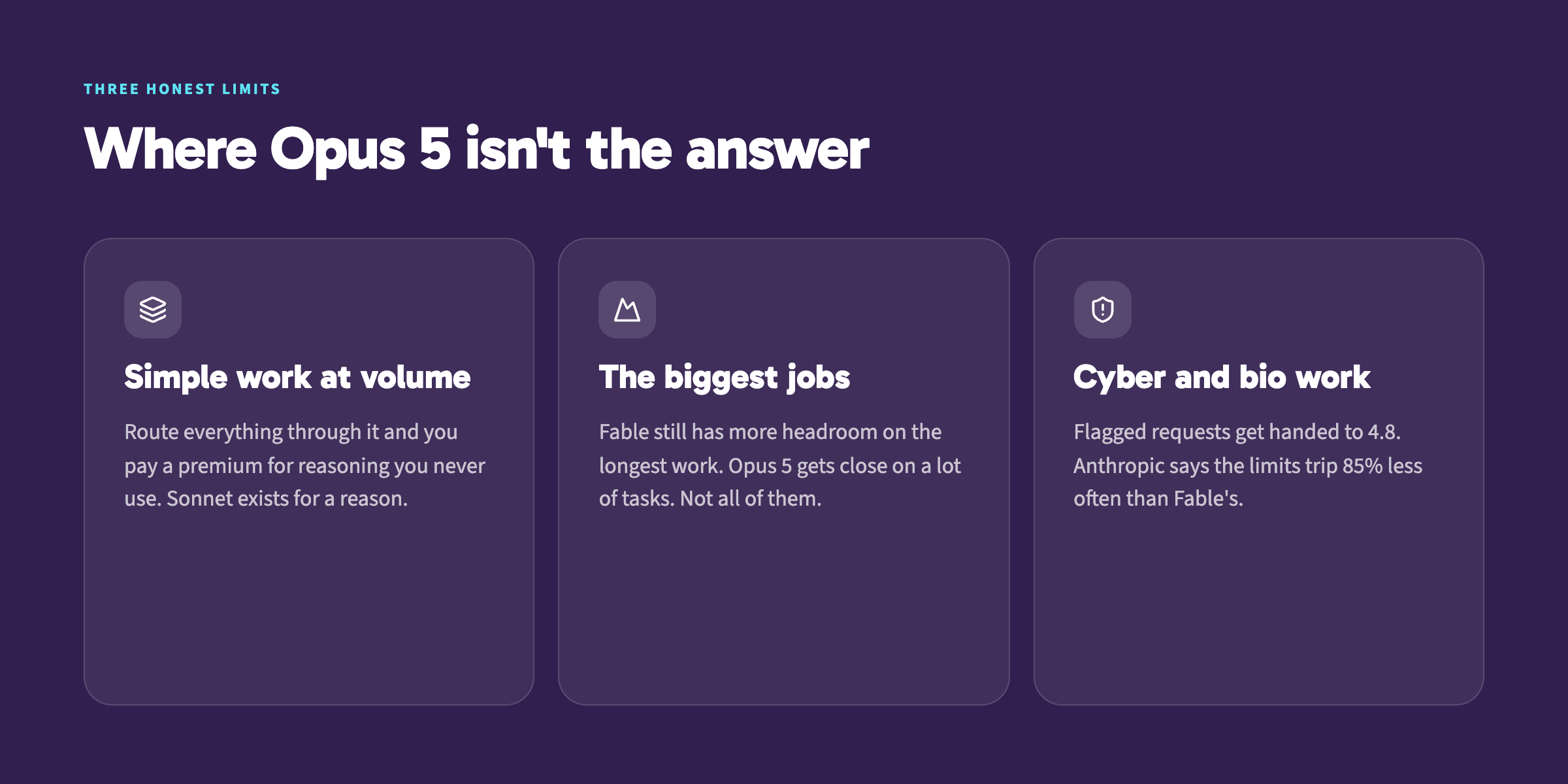
It's overkill for simple work at volume. If you route everything through Opus 5 because it's the default, you're paying a premium for reasoning you're not using. Sonnet exists for a reason.
It's also not the top of the ladder. On the biggest and longest jobs, Fable still has more headroom. Opus 5 gets close on a lot of tasks. Not all of them.
And it has walls around cybersecurity and biology work. It can find vulnerabilities in source code but blocks the offensive side, and flagged requests get quietly handed to the older Opus 4.8 instead. Anthropic says these limits trip about 85% less often than Fable's do, but if your work lives near those areas you'll feel it occasionally.
Bottom line
Opus 5 might be Anthropic's new daily driver. Near top-tier capability, unchanged price, noticeably better judgment, and no data-retention catch.
And actually use the effort setting! It's been there since 4.8, and most people still ignore it, but this is the first version where dialing it down doesn't cost you work quality.
Know someone who'd find this useful?
Forward this to a colleague who's still paying top-tier prices for routine work. They can subscribe at your.biggestgoal.ai to get our briefings daily.