[AI Deep Dive] Why AI Makes Your SMEs More Valuable, Not Less
A post called "LLMs reward expertise" went viral on Hacker News this week. Engineer Sean Goedecke's argument is simple: the most valuable skill when working with a model is knowing the subject. His example is Terence Tao's published ChatGPT transcript on advanced mathematics, where Tao steers the model, spots a weak answer, and proposes a better direction, all because he already understands the mathematics.
For most real work, human judgment is the bottleneck.
Describing exactly what you want, and recognizing when you didn't get it, is the hard part.
As with all these deep dives, this isn't a "don't use AI" piece. Instead, it's designed to bring awareness to the limitations of the tool and how to actually get the most out of it.
Let's dive into this further because it strikes at the core of where working with AI is heading.
The research
You have probably heard something along the lines of "AI levels the playing field and helps weaker performers most." And while that is true, it is also not the whole truth.
SME, also known as a domain expert, is short for Subject Matter Expert. It's someone who has the knowledge required in a specific area to determine if the output presented to them is correct or not.
We've all hit a point while working with AI that butts up against our boundary of knowledge and expertise, taking us into the realm of hoping (read: guessing) that what Claude or ChatGPT says is actually the best solution.
But... AI is also just guessing.
And that, even if you read no further, is exactly why subject matter experts are more important than ever.
So does that mean you have to be an SME to use AI effectively? Not exactly.
Where AI helps non-SMEs
Brynjolfsson, Li, and Raymond studied 5,179 customer support agents (the people version) through a staggered rollout of a generative-AI assistant. Issues resolved per hour rose 14% on average, 34% for novice and low-skilled workers, but close to nothing for the experienced and highly skilled. Noy and Zhang found the same shape in writing tasks with 453 professionals: 40% faster, 18% better quality, with gains concentrated in the bottom half of the skill distribution.
The research produced these results because the lower-skilled workers could get good information faster without having to gain it through years of experience. However, the higher-skilled workers already had that information at the speed of a thought and didn't need to rely on the AI to provide it.
Where AI helps experts
Now let's look at the opposite situation.
Otis and colleagues gave 640 Kenyan entrepreneurs an AI business mentor over WhatsApp for five months. High performers gained roughly 15% in revenue and profit. Low performers declined about 10%.
In this scenario, the weaker operators brought the AI harder problems and had no way to filter what was good or bad advice.
The issue
Here's what it boils down to:
AI compresses skill gaps on well-specified tasks with verifiable outputs. It widens them on ambiguous tasks where knowing that the output is wrong is the entire job.
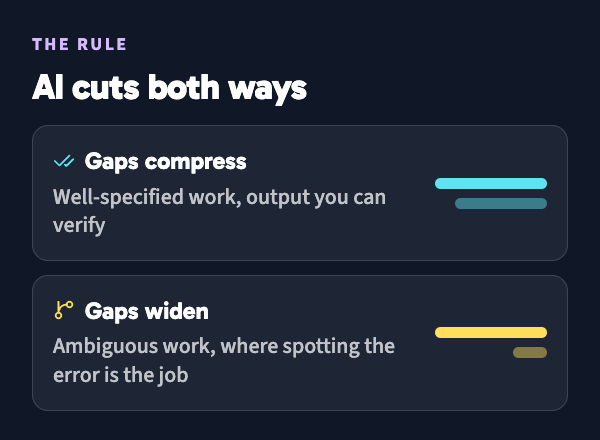
Most of the work your company actually competes on is likely in the second category.
1. What an SME actually is
An SME is someone who can look at an output in their domain and tell you it's wrong.
Credentials don't qualify. Tenure doesn't qualify. Even the ability to produce the work doesn't qualify. Today, the real qualification is being able to recognize a defect at a glance and finding a solution around it.
Three things about that definition:
Expertise is domain-bound and does not transfer. A brilliant operations person might be a novice on compliance regulations.
Recognition runs ahead of articulation. Real experts often can't fully explain their judgment. Articulation is a skill in and of itself.
It is built by consequence, not simple exposure. You develop it by making calls, being wrong, and living with the outcome. In other words, SMEs become SMEs by getting their hands dirty.
I can watch a mason work all day, but by the end of the day I won't be any closer to being a mason than when I started watching.
2. How people build domain expertise when AI does the work
Anthropic ran a randomized trial in January with 52 mostly junior engineers, published Jan 29, 2026. The AI-assisted group scored 50% on a comprehension quiz versus 67% for the group who wrote the code by hand, roughly two letter grades, with the widest gap on debugging questions.
Here's where things get interesting: How people use AI changes comprehension more than whether they used AI or not.
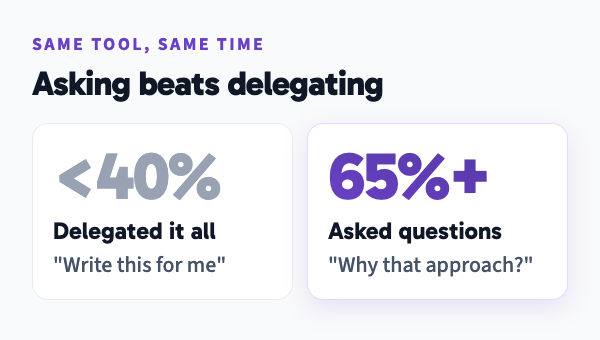
Participants who simply delegated everything to AI averaged under 40% on the quiz.
Participants who asked conceptual and follow-up questions averaged 65% or higher. Same tool, same time, and the gap between those two groups was nearly the same difference between those who used AI and those who didn't.
So here are some things to help support yourself and your team:
Ask instead of delegate. "Write this for me" and "why did you approach it that way, and what would break if the volume doubled" cost the same, but the latter supports comprehension and critical thinking. Make the second one your in-house style, part of your culture and training around AI, because it's the one difference you can implement today.
Keep some things deliberately manual. Reserve a defined slice of work, especially anything that requires critical thinking, as hands-on, because the ability to do it yourself (getting your hands dirty) is the training. The value and the learning is the friction itself. One popular approach making the rounds is retyping AI-generated code, or rewriting generated content, by hand rather than pasting it.
Protect the apprenticeship. Novices acquire the skills they need by working with the subject matter and domain experts, a practice that has been proven for centuries. Think of internships. Internship tasks were never fully about the output created; it was about giving the intern the ability to learn in a real-world situation.
3. AI should not be making judgment calls
Our first rule when we build any AI system is to take the judgment away from the AI by design. Not because models are bad, but because judgment is the one thing you cannot verify after the fact, especially at scale.
AI doesn't have a large enough context window to hold everything it needs to always make the right decision. It also doesn't know what it doesn't know, and yet is confident in its decision most of the time. In other words, AI guesses... a lot.
Just like you wouldn't put business-critical decisions in the hands of a new employee without the "experience" they need to make it. Follow this same rule with AI-based workflows.
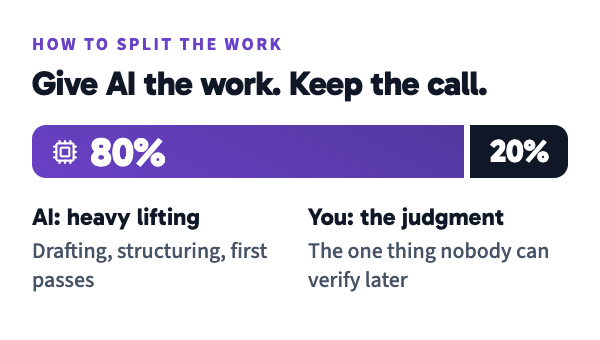
We've all experienced AI's ability to speed up time-consuming tasks on a daily basis. But they are most effective at scale when they do the heavy lifting (say 80% of the work) and then pass the critical judgment back to a person or a team (the remaining 20%).
This is why SMEs are more important than ever.
If the people making the call are just guessing, then the overall product is at risk. However, if the decision is made by an expert, then you have built a process that can produce better results at a much faster rate—and actually improve your bottom line.
4.Where to position a domain expert in the process
The rule is simple: wherever there is a judgment call, there needs to be a person who owns it.
The real work is finding those points. A judgment call is any step where two defensible answers exist and choosing between them requires knowing something not written down.
Here are a few places you might look:
Where judgment hidesThe call someone has to ownAnywhere money movesIs this spend, price, or discount rightAnywhere the output goes to a customerIs this true, and is it ours to sayAnywhere a rule has an exceptionDoes this case qualifyAnywhere data is ambiguousWhich of these conflicting numbers is realAnywhere a plan defines a sequenceWhat has to be true firstAnywhere something is escalatedIs this actually urgentAny handoff between teamsIs this done, or does it just look done
Two questions to ask yourself:
Would a wrong answer here be visible? A plausible-looking wrong answer that flows downstream unnoticed is bad.
Is the reviewer actually an SME in this domain? A review by someone who couldn't produce the work themselves is likely unhelpful.
An example of this in practice: build the constraint (what AI can't/shouldn't do) into the system.
When we run Google Ads with Claude's support, the connection is read-only on purpose. Claude reads the account and generates campaign structures, keyword lists, ad copy, and negative lists, but it cannot publish, move budget, or change bids. A human has to act, which puts the review step exactly where money moves.
The limitation is actually the feature.
5. Where the experts come from
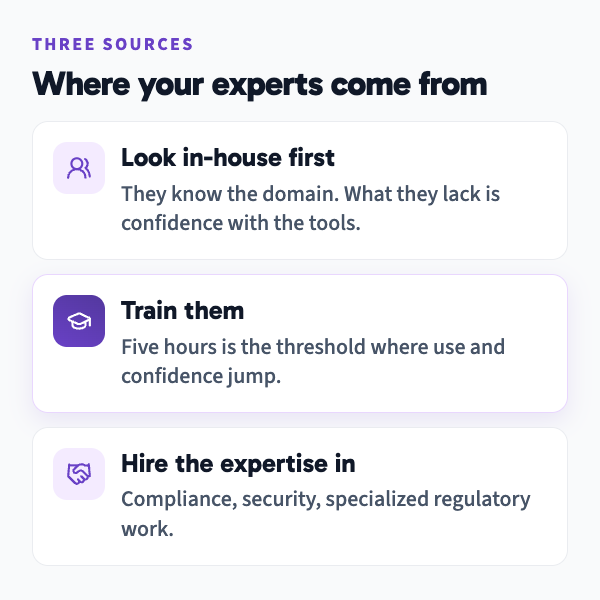
First, in-house, and you almost certainly have more than you think. The people who know your domain are already on your team. What they usually lack is not knowledge but confidence and fluency with the tools, which means they defer to AI output without challenging it because they think that it's "smarter than they are."
Second, train them. BCG surveyed 11,749 workers across 14 markets in June 2026 and found that employees who receive at least five hours of AI training show significantly higher regular use and confidence, with in-person training and coaching outperforming self-serve. Companies with a clear AI strategy saw 25 percentage points more impact.
Real talk: Five hours is a pretty low bar.
Indeed's survey of 1,001 job seekers and 300 employers found nearly 60% of employers now want people who use AI to produce actual work output, while only 14% of employees describe themselves as AI natives, and just 32% say they have had proper training for the job they currently hold.
Third, hire the expertise in.
Bring in outside trainers to build capability in your existing team (by the way, have you met Biggest Goal—this is what we do). This is the most common situation: your domain experts exist, but the AI fluency doesn't.
Hire or contract the domain expertise itself when you genuinely don't have it, most often in compliance, security, and specialized regulatory work.
The bottom line
AI made producing the work nearly free. It did not make being right free, and it didn't make being right any easier to verify.
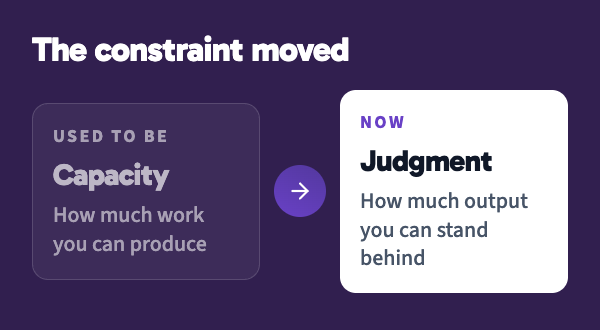
Which means the constraint moved. It used to be capacity: how much work could your team produce. Now it's judgment: how much output can your team actually stand behind. Buying more capacity when judgment is the issue just produces more things nobody has checked.
Put another way: You don't want to design systems that 10x bad judgment.
The companies that will continue to scale with AI know exactly where in their process a person has to make a decision and put the right people in place to make them.
Know someone who'd find this useful?
Forward this to a colleague who wants to share concepts like this with their boss but doesn't know how. They can subscribe at your.biggestgoal.ai to get our briefings and deep dives for free.
If you want help finding the judgment points in your own process and deciding who should own them, grab a free 30-minute session with me.
Source notes
"LLMs reward expertise" and the Tao example: seangoedecke.com, Aug 3 2026 · Hacker News, 1,042 points
Retyping AI code to prevent cognitive debt: ankursethi.com · Hacker News, 503 points
Novices gain most, 5,179 support agents: Brynjolfsson, Li & Raymond, NBER w31161
Writing tasks, 453 professionals: Noy & Zhang, Science 2023
High performers +15%, low performers -10%, 640 Kenyan entrepreneurs: Otis et al., Management Science · SSRN working paper
Comprehension gap 50% vs 67%, 52 engineers, Jan 29 2026: Anthropic
Five-hour training threshold, 11,749 workers across 14 markets: BCG AI at Work, June 2026
60% of employers want AI-native talent, 14% of workers are: Indeed · CIO Dive
Kaiser Permanente 15-month build and monthly governance review: Becker's Hospital Review