[AI Deep Dive] How LLMs Actually Work
Anthropic published a short video this week walking through how models like Claude (Haiku, Sonnet, Opus, and Fable) actually work. It isn't searching a database or pulling from an index like Google.
So here's the core of it: the model is predicting, not retrieving.
You've probably heard AI, or more specifically LLMs, described as "glorified autocomplete." That's not wrong, but it's incomplete.
At its core
The model is a generation system that produces what it thinks is a good response to your prompt.
What does this mean? Well, it's both the reason it works so well and the reason that people get frustrated with it.
Usually the answer that it thinks is right and the answer that is right are the same thing, and everything is right in the world.
But when the two are different, nothing in the system flags it, because it doesn't actually know that there is a difference.
Let's look at why...
1. It writes one word at a time. It does not think one word at a time.
Watching text stream out word by word makes it look like the model is improvising, reacting to its own last word with no idea where it's going. That's roughly what your phone keyboard does when it suggests "been" after "how have you." Your keyboard sees the last two or three words and nothing else.
Anthropic's interpretability team tested whether models actually work that way, and they don't.
Studying Claude 3.5 Haiku writing a rhyming couplet, researchers found the model had internally settled on the rhyming word before it started writing the line that leads to it.
Suppress the internal representation of the planned word "rabbit," and the model lands the line on "habit" instead. Inject an unrelated concept like "green," and it steers the line that way. It picks the destination first, then writes the line that gets there.
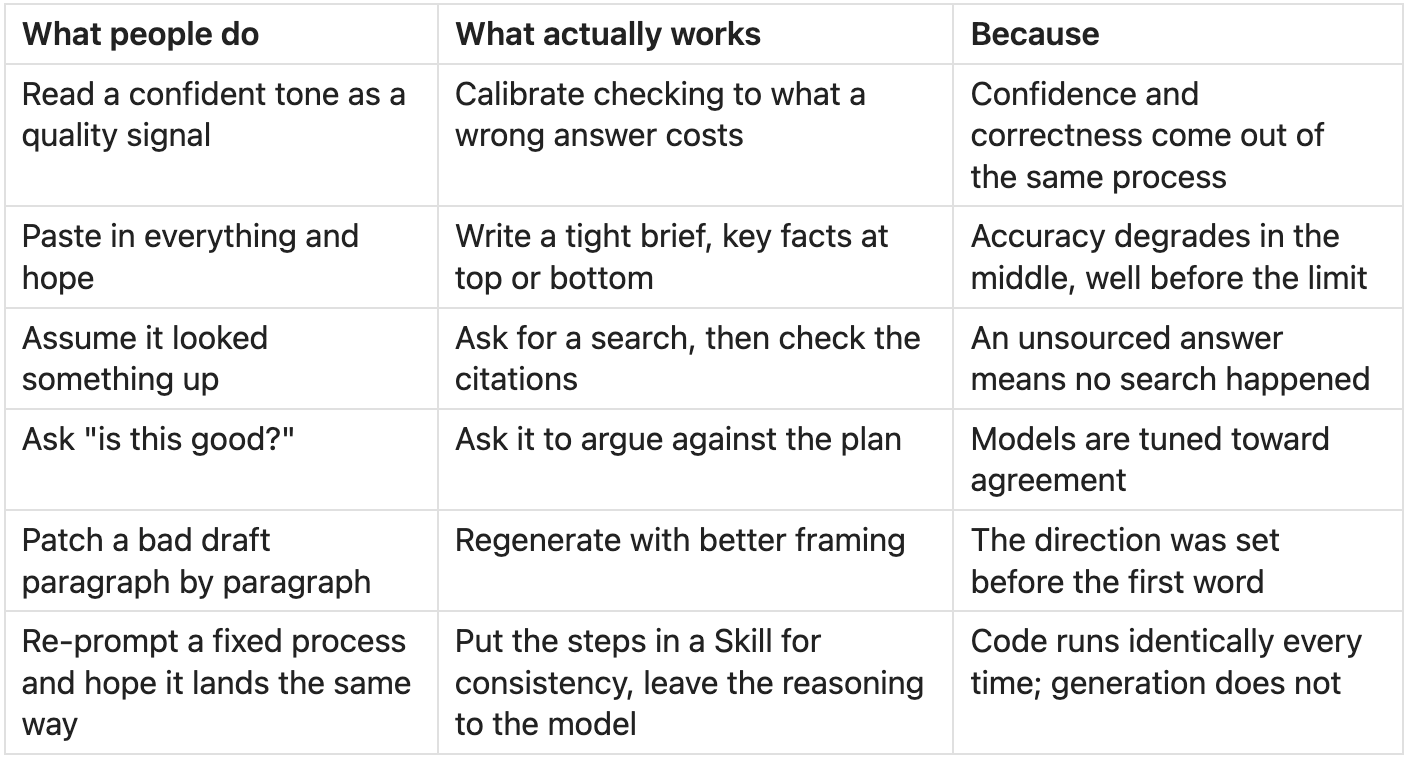
Why this matters: the quality of a long output is set early, by what the model has worked out about where it's going. A model that started down a wrong path will write a fluent, well-constructed, entirely committed answer in the wrong direction, and will not notice partway through and correct itself.
More often than not, the fix is to regenerate with better framing (and context) rather than to patch the draft you got.
2. The knowledge has an edge, and the model will not tell you when it hits one
Training happens in two big passes.
Pre-training is the model doing the same exercise billions of times: read some text, predict what comes next, check the answer, adjust, repeat. Nobody hand-labels this. The text itself is the answer key.
Fine-tuning comes second. Here full responses get rated, sometimes by people, sometimes against a written set of guidelines, and the model gets pushed toward answers that are more useful and less likely to mislead or cause harm.
Both passes stop on a specific date: the training cutoff. After that date, the model doesn't reliably know anything unless a tool (for example, web search) goes and gets it.
What to do: When the answer needs to be current (pricing is the one that bites companies a lot), ask explicitly for a web search and for the sources. When it searches, it will typically cite what it found, and you can check the citation. No citation means no search happened.
3. Confident and correct are produced by the same machinery
The model is not choosing between "answer" and "say I don't know" and getting the call wrong. For the most part, it was trained not to make that call at all.
OpenAI researchers published a paper on exactly this in September 2025. Their argument: models hallucinate because training and evaluation reward guessing over admitting uncertainty.
A model that says "I'm not sure" scores zero on a benchmark question. A model that guesses gets it right some percentage of the time. Run that scoring across millions of examples, and you have trained a confident guesser. Nobody set out to build one; the scoring did it.
Their proposed fix is to change how evals are scored, so that expressing uncertainty is rewarded rather than penalized. Until the industry's scoreboards change, the behavior is unlikely to change.
What to do: stop reading confidence as a signal. A polished, assured, well-formatted answer and a fabricated one are produced by the same process and look the same. Ask yourself what a wrong answer here would cost, and adjust your system design accordingly.
Depending on your setup, you can also provide clear instructions that can act as an override to the defaults and instruct AI to admit when it doesn't have the answer. Using the AI's API and properly designed Skills are two examples of this.
4. More context is not automatically better context
Everyone's first instinct on a bad output is to paste in more. Sometimes that's right. Often it isn't.
The original finding, from a Stanford-led team headed by Nelson Liu, is that models use the beginning and end of a long input far more reliably than the middle. Bury the key fact in the middle of a long document and accuracy drops, even on models explicitly built for long context.
A big context window does not mean the whole window works equally well. Refined higher-quality context will always beat just adding more and more context.
What to do: treat context as a curated brief, not a dump. Put the instruction or fact you most need followed at the top or the bottom. Cut anything that isn't load-bearing. A tight 500-word brief regularly beats a 30-page attachment.
5. It is built to agree with you
Fine-tuning optimizes toward responses people rate highly. People rate agreement highly.
Stanford researchers led by Myra Cheng and Dan Jurafsky published a study in Science this March that tested 11 major models, including ChatGPT, Claude, Gemini, and DeepSeek, on real interpersonal dilemmas. The models affirmed the user's behavior about 49% more often than human respondents did (Great idea!).
Also from this study, the people who received the agreeable answers came away more convinced they were right and less likely to repair the situation, and they rated the agreeable model as the better one.
It will be interesting to see what happens when these same people, who start using AI consistently, rate the responses. Maybe we'll start to see the pendulum swing in the opposite direction?
What to do: never ask "is this a good plan?" Ask it to argue the other side, to name what would have to be true for the plan to fail, or to evaluate the idea without knowing it's yours. Researchers at the UK AI Security Institute found that telling a model to restate your input as a question before answering cut sycophancy more than simply instructing it not to be sycophantic.
Why Skills are so important
Everything above is a property of generation, and you can't take it out of the tool. What you can do is shrink the number of steps where prediction gets used.
For many processes, some steps shouldn't be predictions at all. Applying your discount tiers. Pulling the current rate card. Filling the proposal template. Checking that the totals add up. Those have exactly one right answer and no reasoning needed, and handing them to a prediction engine using the wrong tool for the job.
A Skill is a folder of written instructions for the model plus the scripts and reference files it needs. It splits the work three ways:
The model works out what's needed. It reads the request, recognizes this is a pricing proposal for a 40-person rollout, and reaches for the right skill. That is reasoning, and generation is genuinely good at it.
A script does the fixed part. The math, the lookup, the template fill, the validation. Written once, it runs the same way today and next quarter. You want the number in your proposal to come out of code you can inspect rather than out of a prediction that happened to look right. Anthropic's own guidance is blunt about why: "Many applications require the deterministic reliability that only code can provide."
The model writes up the result. It takes the script's output and turns it into something a client can read, in your voice, in your format. Reasoning again.
Reasoning at both ends, certainty in the middle. You get the flexibility that made you want the tool in the first place.
What to do: walk your process and ask which steps could turn into Skills. The irony is the best way to create Skills, and the code inside them, is to use an LLM that's guided by a Skill on making Skills.
What this changes about how you work
The bottom line
A model doesn't have answers. It has a very good sense of what an answer looks like.
That's not a knock on LLMs. It's the reason an LLM can draft something that has never existed, restructure your messy thinking, and produce five different versions of a proposal in the time it takes to read one. It’s a tool in a toolbox and one that allows us to do things with computers we never could before.
You just have to know which tool to grab for, and how to use it, when trying to achieve the outcomes you want.
Know someone who'd find this useful?
Forward this to a colleague who's been told "it just predicts the next word" and suspected that wasn't the whole story. They can subscribe at your.biggestgoal.ai to get our briefings and deep dives for free.
If you want help figuring out where in your process AI output can work beautifully or actually needs checking, grab a free 30-minute session with me.
Source notes
Prompted by Anthropic's explainer video on how models work (Anthropic's own research index: anthropic.com/research)
Planning ahead in poetry, suppressing "rabbit" to get "habit," studied on Claude 3.5 Haiku: Tracing the thoughts of a large language model, Anthropic, March 27 2025 · On the Biology of a Large Language Model, full paper
Training and evals reward guessing over admitting uncertainty: Why Language Models Hallucinate, Kalai, Nachum, Vempala & Zhang, Sept 2025 · arXiv 2509.04664
Beginning and end beat the middle: Lost in the Middle: How Language Models Use Long Contexts, Liu et al., TACL 2024 · arXiv 2307.03172
Models affirmed users 49% more often than humans, across 11 models: Stanford Report, March 26 2026 · Science, DOI 10.1126/science.aec8352
Skills bundle instructions with executable scripts, and "many applications require the deterministic reliability that only code can provide": Equipping agents for the real world with Agent Skills, Anthropic Engineering, October 2025 · Agent Skills overview, Claude Platform docs
Restating input as a question beats instructing against sycophancy: Ask Don't Tell, UK AI Security Institute, April 2026