AI Agents vs. Traditional Automation
How one simple pattern eliminates the endless cycle of updating automations every time your business changes.
Since 2019, I’ve been helping businesses around the world systematize their operations, enabling them to scale effectively. Before that, I scaled my own business to over 600 active clients. Through all this experience, I’ve witnessed the same frustrating cycle play out countless times: businesses build complex automations, their workflows evolve, and suddenly they’re stuck rebuilding everything from scratch.
Today, I would like to share a specific AI agent design pattern that addresses this issue once and for all. This approach will help your workflows adapt and scale naturally, without the constant maintenance headache that traditional automation requires.
The Problem with Traditional Automation
Let me paint a picture you’ve probably lived through. Your team creates a form for task requests. Marketing needs something; they fill out the form, and your automation routes it to the marketing task list. Finance needs something; they fill out the form, and it goes to the finance task list. Everything works perfectly.
Then your business grows. You add a new department. Suddenly, you’re back in your automation tool, adding new form fields, creating new routing logic, updating conditions, and praying you don’t break something that was already working. What should be a simple addition becomes an hour-long editing session across multiple tools and workflows.
This is the bane of founders and team leaders who want to automate their processes. Every workflow change requires a major automation update, which costs time, creates potential bugs, and often delays the very growth you’re trying to enable.
The AI Agent Solution
Here’s where AI agents change everything. Instead of hardcoded routing logic, we use an intelligent agent that can make contextual decisions, just like a human would.
Let me illustrate this with a real-world example.
The Setup
I created a simple demonstration using ClickUp with two lists: “Marketing Tasks” and “All Other Tasks.” The magic happens with an AI agent that has access to just two tools:
Get Available Lists — It can see what task lists exist in the workspace
Create New Task — It can create tasks in any of those lists
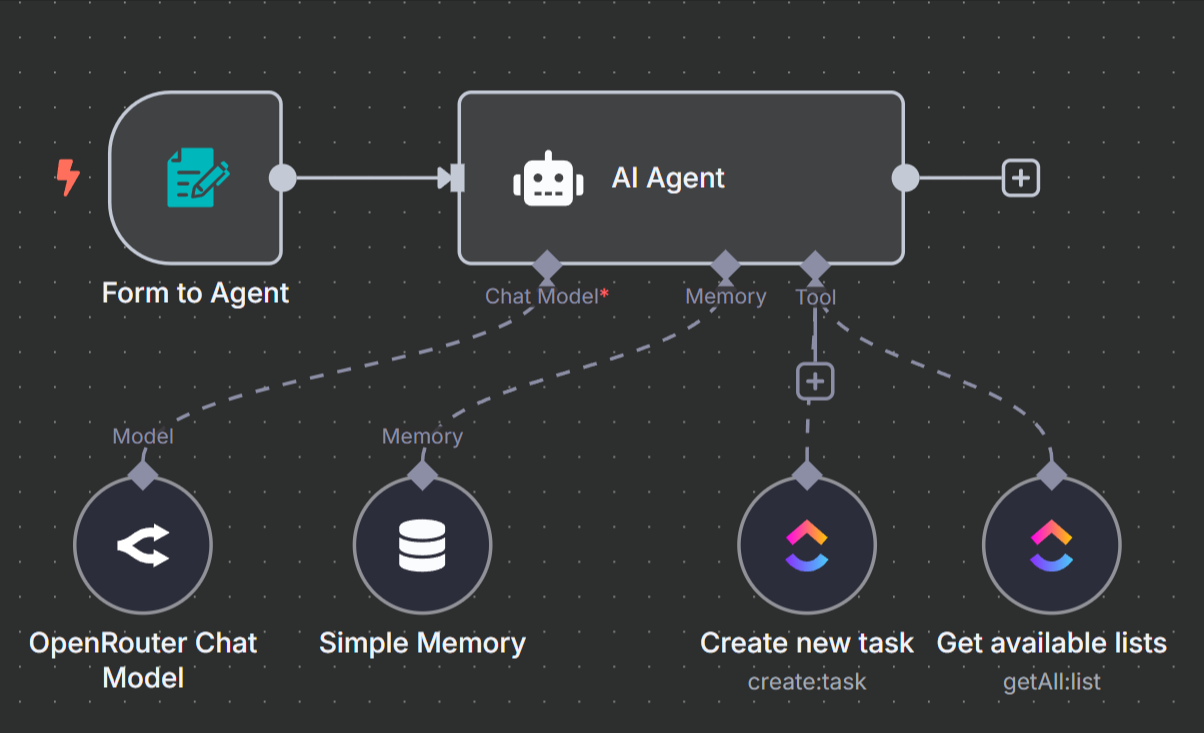
The agent’s instructions are beautifully simple: “Review the task provided, determine what type of task it is, and move it into the correct list.”
That’s it. No complex routing logic. No hardcoded conditions. Just intelligent decision-making.
Seeing It in Action
When someone submits a request like “Create one-sheeter for our new courses,” the agent:
Retrieves all available lists
Analyzes the request content
Determines its marketing-related
Creates the task in the Marketing Tasks list
Even optimizes details like setting due dates strategically
The beautiful part? The agent automatically improves the task title and adds context. Instead of just copying the form submission, it might change “Create one-sheeter for our new courses” to something more descriptive and actionable.
The Real Magic: Effortless Scaling
Here’s where this approach becomes transformative. Let’s say your business grows and you need to add a Finance department.
In traditional automation, this means:
Updating your form to include “Accounting” as an option
Adding new routing conditions
Creating new automation branches
Testing everything to make sure you didn’t break existing workflows
Updating multiple connected systems
With the AI agent approach, you simply create a new “Accounting Tasks” list in ClickUp. That’s it.
When someone submits a request for “a new P&L report,” the agent automatically:
Sees the new Finance Tasks list (because it gets all available lists dynamically)
Recognizes this is a finance-related request
Routes it appropriately
Even optimizes the task title to “Create P&L Report for 2024”
No form updates. No automation edits. No risk of breaking existing functionality.
Traditional vs. AI-Powered: A Side-by-Side Comparison
Traditional Automation Approach
Setup Time: Hours of initial configuration
Maintenance: Major updates every time business processes change
Scalability: Each new department/workflow requires manual intervention
Error Risk: High — complex routing logic is prone to bugs
Flexibility: Low — hardcoded conditions can’t adapt to nuanced requests
AI Agent Approach
Setup Time: Minutes of simple configuration
Maintenance: Add new lists/categories as needed — that’s it
Scalability: Automatic adaptation to new departments and workflows
Error Risk: Low — intelligent decision-making reduces logic errors
Flexibility: High — can handle unexpected scenarios and nuanced requests
Implementation Strategy
If you’re ready to implement this pattern in your own business, here’s how to get started:
1. Identify Your Routing Scenarios
Look for places where you currently use complex conditional logic to route tasks, emails, or requests. These are prime candidates for AI agent replacement.
2. Start Simple
Begin with a basic categorization scenario, such as the one I demonstrated. Don’t try to automate everything at once.
3. Design for Dynamic Discovery
Instead of hardcoding destinations, give your agent tools to discover available options dynamically. This is the key to future-proofing your automation.
4. Keep Instructions Clear but Flexible
Your agent instructions should be simple enough to understand but flexible enough to handle edge cases intelligently.
5. Test and Iterate
Start with low-risk scenarios and gradually expand as you build confidence in the system.
The Bigger Picture
This design pattern represents a fundamental shift in how we think about automation. Instead of trying to anticipate every possible scenario and code for it explicitly, we’re creating intelligent systems that can adapt and make decisions contextually.
This isn’t just about saving time on updates (though you’ll save hours). It’s about building automation that grows with your business instead of constraining it. It’s about creating systems that become more valuable over time rather than more burdensome.
Getting Started Today
The tools to implement this pattern are available right now. Whether you’re using ClickUp, Asana, Monday.com, or any other modern business tool with API access, you can start building adaptive AI agents that eliminate the automation maintenance cycle.
The key is to start thinking like an architect rather than a programmer. Instead of building rigid, rule-based systems, design flexible, intelligence-based systems that can evolve with your needs.
Your future self (and your team) will thank you for making this shift now, before your automation debt becomes unmanageable.
Ready to transform your workflow automation? The pattern I’ve outlined here is just the beginning. As AI capabilities continue to advance, the businesses that learn to leverage intelligent automation today will have a massive competitive advantage tomorrow.